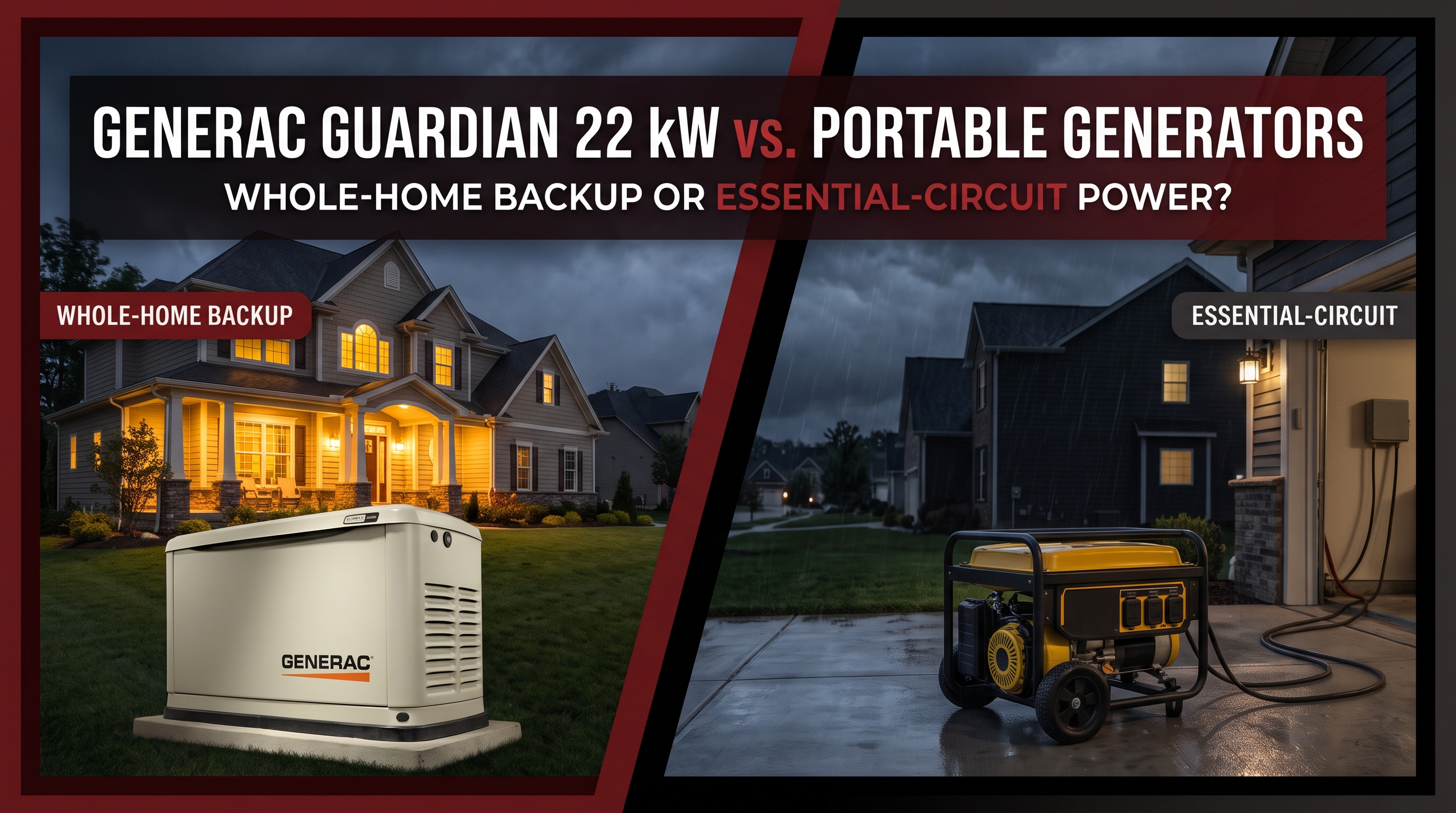
Generac Guardian 22 kW vs. Portable Generators: Whole-Home Backup or Essential-Circuit Power?
When the power goes out, a generator can help keep essential appliances running, protect refrigerated food and support everyday household needs. But not every backup generator is designed to do the same job.
A permanently installed standby generator can automatically provide backup power when utility electricity fails. A portable generator offers a different advantage: flexibility, lower initial equipment costs in many cases and the ability to move power where it is needed.
If you are comparing the Generac Guardian 22 kW, the PREDATOR 3500 Watt Dual-Fuel Inverter Generator and the DuroMax XP5500EH, the first question is not simply which generator produces the most watts. It is which system best fits your home's electrical demands, installation options, budget and preferred level of convenience.
This guide compares the three options to help you build a practical backup-power shortlist.
Quick Comparison: Standby vs. Portable Generators
| Feature | Generac Guardian 22 kW | PREDATOR 3500 Dual-Fuel | DuroMax XP5500EH |
|---|---|---|---|
| Generator type | Permanently installed standby | Portable inverter | Portable conventional generator |
| Primary use | Automatic residential backup | Smaller loads and portable power | Essential loads and selected larger appliances |
| Fuel | Natural gas or liquid propane | Gasoline and propane, subject to the exact model specifications | Gasoline and propane |
| Starting and transfer | Automatic operation with a compatible transfer system | Portable setup and manual connection | Portable setup and manual connection |
| Installation | Professional site assessment and electrical/gas installation | Outdoor setup and suitable electrical connections | Outdoor setup and suitable electrical connections |
| Best fit | Buyers prioritizing automatic backup and greater capacity | Buyers prioritizing portability and inverter-style power | Buyers wanting more output than a small portable inverter may provide |
| Main trade-off | Higher purchase and installation commitment | Limited available power compared with a large standby system | Requires more user involvement and careful load management |
Specifications, fuel performance and included components vary by model and configuration. Verify the exact product listing and manufacturer's documentation before ordering.
1. Generac Guardian 22 kW: Automatic Backup for Your Home
The Generac Guardian 22 kW is designed for residential standby power. Unlike a portable generator that must be positioned and connected when needed, a properly installed standby system is designed to respond to a utility outage automatically.
The model listed in the LBRAWEE catalog includes Wi-Fi connectivity and a 200-amp transfer switch.
What makes a standby generator different?
A standby generator is installed at a designated outdoor location and connected to the home's electrical system through a compatible transfer switch. Depending on the installation and selected configuration, the system can supply designated circuits or support a much larger portion of the home's electrical demand.
The Generac Guardian specification identifies output ratings of up to 22,000 watts on liquid propane and 19,500 watts on natural gas. Actual available capacity depends on the fuel supply, installation and operating conditions.
A transfer switch manages the change between utility power and generator power. It is an essential part of a correctly designed standby installation, not an optional substitute for safe electrical connection.
Who should consider the Generac Guardian?
This option is worth evaluating if you:
- Want backup power to start without manually deploying a portable generator.
- Have several essential household circuits to support during outages.
- Need to evaluate larger electrical loads, potentially including selected HVAC equipment.
- Prefer a permanent outdoor installation.
- Are prepared for professional installation and ongoing maintenance.
The 22 kW rating does not automatically guarantee that every appliance in every home can run simultaneously. Air conditioning, electric heating, electric water heaters, well pumps and other motor-driven equipment can create substantial starting and running loads.
Have a qualified electrician calculate the home's load requirements before selecting the system.
Explore the Generac Guardian
The Generac Guardian is the product to investigate first if automatic operation and greater residential backup capacity are your priorities.
2. PREDATOR 3500 Watt Dual-Fuel Inverter Generator: Portable Power and Flexibility
A portable inverter generator suits buyers who do not need—or do not want to install—a permanently connected standby system.
The PREDATOR 3500 Watt Dual-Fuel Super Quiet Inverter Generator in the LBRAWEE catalog is an option for evaluating portable backup, recreational use and selected household essentials.
Why choose an inverter generator?
Inverter generators use electronic power conversion to provide controlled electrical output. Depending on the model, this can be useful for compatible electronics and smaller electrical loads.
The Predator's advertised 3,500-watt class does not mean that every appliance requiring up to 3,500 watts will necessarily start and operate successfully. Continuous output, starting demand, fuel type and the particular electrical connection all matter.
Check the manufacturer's rated and peak output specifications before connecting equipment.
Is a portable inverter suitable for home backup?
It may be suitable for selected loads, such as:
- Routers and communication equipment.
- Lights and other modest electrical loads.
- Selected refrigerators, if their starting requirements are within the generator's capability.
- Other compatible equipment whose combined demand stays within the rated output.
A portable generator of this size is not a direct substitute for a 22 kW standby system. Larger central air conditioners, electric heating equipment and multiple high-demand appliances can exceed its capacity.
What about dual-fuel operation?
Dual-fuel capability gives the owner a choice between compatible fuel sources. The practical value depends on fuel availability, storage arrangements, runtime and the generator's output on each fuel.
Do not assume that rated output or runtime is identical on gasoline and propane. Check the model-specific manual for the correct figures.
Explore the Predator
Consider this model if portability, a smaller footprint and flexible use are more important than supplying a large portion of the home's electrical demand.
3. DuroMax XP5500EH: A Portable Option for Selected Essential Loads
The DuroMax XP5500EH is another portable dual-fuel generator in the LBRAWEE catalog. Its advertised 5,500-watt peak class makes it a different option to compare with a smaller portable inverter.
Manufacturer documentation lists a gasoline rating of 5,500 peak watts and 4,500 rated watts, with different figures for propane operation. Confirm these figures against the exact model documentation supplied with the product.
When does a larger portable generator make sense?
A higher-output portable generator can give you more flexibility when supporting a carefully selected group of household loads. Depending on its available output and connections, that might include a refrigerator, lighting, communication equipment and certain pumps or other appliances.
However, adding up appliance running watts is only the first step. Motors and compressors can require considerably more power at startup. Two appliances that each operate within the generator's rating may still exceed its capability when starting simultaneously.
A larger portable generator also does not become a whole-house standby system simply because its peak rating is higher.
Gasoline or propane?
The DuroMax XP5500EH offers two fuel options, allowing owners to plan around the fuel they can obtain and store safely.
Consider the following before buying:
- The generator's rated output on each fuel.
- Fuel consumption at the loads you intend to operate.
- Manufacturer-approved fuel connections and operating procedures.
- Safe fuel storage and refueling practices.
- Maintenance and storage requirements between outages.
Propane can be convenient for owners who already have a suitable supply, while gasoline may be more accessible in other situations. Neither fuel guarantees uninterrupted operation if supplies run out or conditions prevent safe use.
Explore the DuroMax
This model is worth comparing if you want a portable option with more output than a smaller inverter generator and are comfortable managing setup, connections, fuel and load priorities yourself.
4. How Much Generator Power Does Your Home Actually Need?
Generator sizing is one of the most important steps in the buying process.
Start by listing the appliances and circuits you want to keep operational during an outage. Then determine their running wattage, startup demand, voltage and connection requirements.
Step 1: List your essential appliances
Your list might include:
- Refrigerator or freezer.
- Selected lights.
- Wi-Fi router and communication equipment.
- Sump or well pump, where applicable.
- Medical or other essential equipment.
- Heating-system controls or selected HVAC equipment.
The correct list depends on your home, climate, household needs and the electrical systems installed.
Step 2: Estimate running wattage
For each appliance, record its running wattage from the nameplate or manufacturer's documentation.
Add the running loads you expect to use at the same time.
For example, if the loads you have selected require 1,200 watts, 300 watts and 200 watts during normal operation, their combined running demand is 1,700 watts.
This is an illustrative calculation, not a recommendation that any particular generator can safely start or operate those appliances.
Step 3: Account for startup demand
Refrigerators, pumps, air conditioners and other motor-driven equipment can draw additional power when starting.
Check the appliance documentation and the generator's surge capability. Do not assume the generator's peak rating can be used continuously or that all starting loads can be accommodated simultaneously.
Step 4: Check voltage and connections
Wattage alone is not enough. Some appliances require 240-volt service, while others use 120-volt connections.
A generator must have the appropriate output, receptacles and protection for the intended equipment. A qualified electrician should assess connections to household wiring and any transfer equipment.
Step 5: Decide how much of the home needs backup
There are two common approaches:
Essential-circuit backup: Prioritize selected circuits and appliances rather than attempting to power the entire property.
Whole-home or broad-load backup: Evaluate a standby system sized for the household's electrical demand, with any necessary load management.
The right choice depends on your budget, power requirements and tolerance for manually prioritizing appliances.
5. Standby vs. Portable: Which Costs Should You Compare?
The purchase price is only one part of the total cost of owning a generator.
| Cost factor | Standby generator | Portable generator |
|---|---|---|
| Initial equipment | Typically a larger investment | Often lower initial equipment cost |
| Installation | Site preparation, electrical work and fuel connections may be required | Setup is simpler, but safe electrical connections and any transfer equipment still matter |
| Fuel | Natural gas or propane, depending on the model | Fuel type depends on the model |
| Maintenance | Scheduled servicing and system checks | Engine maintenance, fuel management and storage |
| Outage preparation | Designed for automatic operation after proper installation | Usually requires deployment, inspection and connection by the owner |
| Long-term convenience | Greater automation | Greater portability and flexibility |
Prices, installation charges and fuel costs vary by location and project. Compare current product prices alongside installation estimates, maintenance requirements and the cost of any required accessories.
For the Generac, obtain an installation quote that accounts for the electrical service, fuel supply, site requirements and the exact transfer-switch configuration.
For a portable generator, include the cost of safe storage, suitable cables or approved connections, any necessary transfer equipment and fuel management.
6. Automatic Transfer Switches: What Homeowners Should Know
An automatic transfer switch monitors the utility supply and coordinates the change to generator power when the system is configured for automatic operation.
When utility power returns and the system confirms that conditions are suitable, the transfer equipment can return the home to utility power according to its operating sequence.
The exact timing depends on the equipment, settings and operating conditions. Do not assume every standby generator restores power in exactly 10 seconds.
A portable generator should not be connected to household wiring by plugging it into a wall outlet. This dangerous practice, known as backfeeding, can expose utility workers and occupants to electrical hazards.
If you intend to power household circuits from a portable generator, ask a qualified electrician about a properly installed transfer switch or another code-compliant connection method.
7. Generator Safety: Essential Before You Buy
Backup power should never come at the expense of household safety.
Portable generators produce carbon monoxide, an odorless and potentially fatal gas. Follow these precautions:
- Operate portable generators outdoors only.
- Keep them at least 20 feet away from the home, doors, windows and vents, directing exhaust away from buildings.
- Never operate a portable generator inside a home, garage, basement, shed or other enclosed space—even if doors or windows are open.
- Install working carbon monoxide alarms on each level of the home and outside sleeping areas.
- Follow the manufacturer's instructions for operation in wet weather, grounding where applicable, electrical connections and refueling.
- Turn the generator off and allow it to cool before refueling, following the owner's manual.
- Keep fuel stored in approved containers and away from ignition sources.
For a permanently installed standby generator, follow the manufacturer's placement and clearance requirements, local codes and the installation professional's guidance.
Read the CPSC's generator safety guidance before planning a portable-generator setup.
8. Which Generator Should You Choose?
The best choice depends on how much power you need, how you want to operate the system and what you are prepared to spend on installation and ownership.
Choose the Generac Guardian 22 kW if:
- Automatic backup is a major priority.
- Your household requires more electrical capacity than a small portable generator can provide.
- You want to investigate a permanently installed system.
- You are prepared to arrange professional installation and maintenance.
Choose the PREDATOR 3500 if:
- You want a portable inverter generator.
- Your planned loads are relatively modest.
- Portability and flexible use are important.
- You have confirmed that its rated output, startup capacity and connections suit your appliances.
Choose the DuroMax XP5500EH if:
- You prefer a portable dual-fuel generator.
- Your intended loads may require more capacity than a smaller inverter generator offers.
- You want to compare gasoline and propane operation.
- You are comfortable managing the generator's setup, safe operation, fuel and electrical connections.
Before ordering any of these models, verify its current specifications, included accessories, availability, warranty terms and installation requirements.
Frequently Asked Questions
Is a 22 kW generator enough to power an entire house?
It may be sufficient for many residential loads, but not every home has the same electrical demand. Central air conditioning, electric heating, water heaters, pumps and other high-demand equipment can change the sizing calculation. Have your actual loads assessed before choosing a generator.
Is a portable generator cheaper than a standby generator?
Portable generators often have a lower initial equipment cost and generally avoid the full installation commitment of a permanent standby system. However, safe household connections, transfer equipment, fuel, maintenance and accessories can add to the total cost. Compare the complete setup rather than the generator price alone.
Can a portable generator run a refrigerator and other essential appliances?
Potentially, if the combined running load, startup demand, voltage and connections are compatible with the generator. Check each appliance's requirements and the generator's rated output before use.
What is the difference between peak watts and rated watts?
Peak watts describe a generator's short-term maximum output under specified conditions. Rated watts describe its sustained operating output. Use rated output as the starting point for load planning and account separately for appliance startup demand.
Should I choose gasoline or propane?
The better option depends on the generator's specifications, fuel availability, storage conditions and expected runtime. Dual-fuel capability offers flexibility, but output and fuel consumption may differ between fuel types.
Do I need an electrician for a home backup generator?
A permanently installed standby system requires appropriate professional installation. For a portable generator intended to supply household circuits, consult a qualified electrician about a safe, code-compliant connection method. Never backfeed household wiring through a wall outlet.
Final Verdict: Match the Generator to Your Backup Plan
The Generac Guardian 22 kW, PREDATOR 3500 and DuroMax XP5500EH serve different backup-power needs.
The Generac is the option to investigate if you prioritize automatic residential backup and greater capacity. The Predator is a portable inverter option for more modest loads, while the DuroMax provides another portable dual-fuel choice for buyers evaluating higher output.
Start with the appliances you need to operate, calculate their running and startup demands, and compare the total ownership cost of each solution.
Ready to compare your options? Browse the LBRAWEE generator catalog and review the specifications of the models that fit your requirements.
Sources and Further Reading
authoritative resources to verify product specifications :
- Generac — Guardian 22 kW Standby Generator
- Generac — Guardian 16–22 kW Specification Sheet
- U.S. Consumer Product Safety Commission — Generator Safety
- Centers for Disease Control and Prevention — Carbon Monoxide Safety
- DuroMax — Generator Manuals
- LBRAWEE — Generators and Portable Power
- LBRAWEE — Portable Inverter vs. Dual- and Tri-Fuel Generators for Home Backup