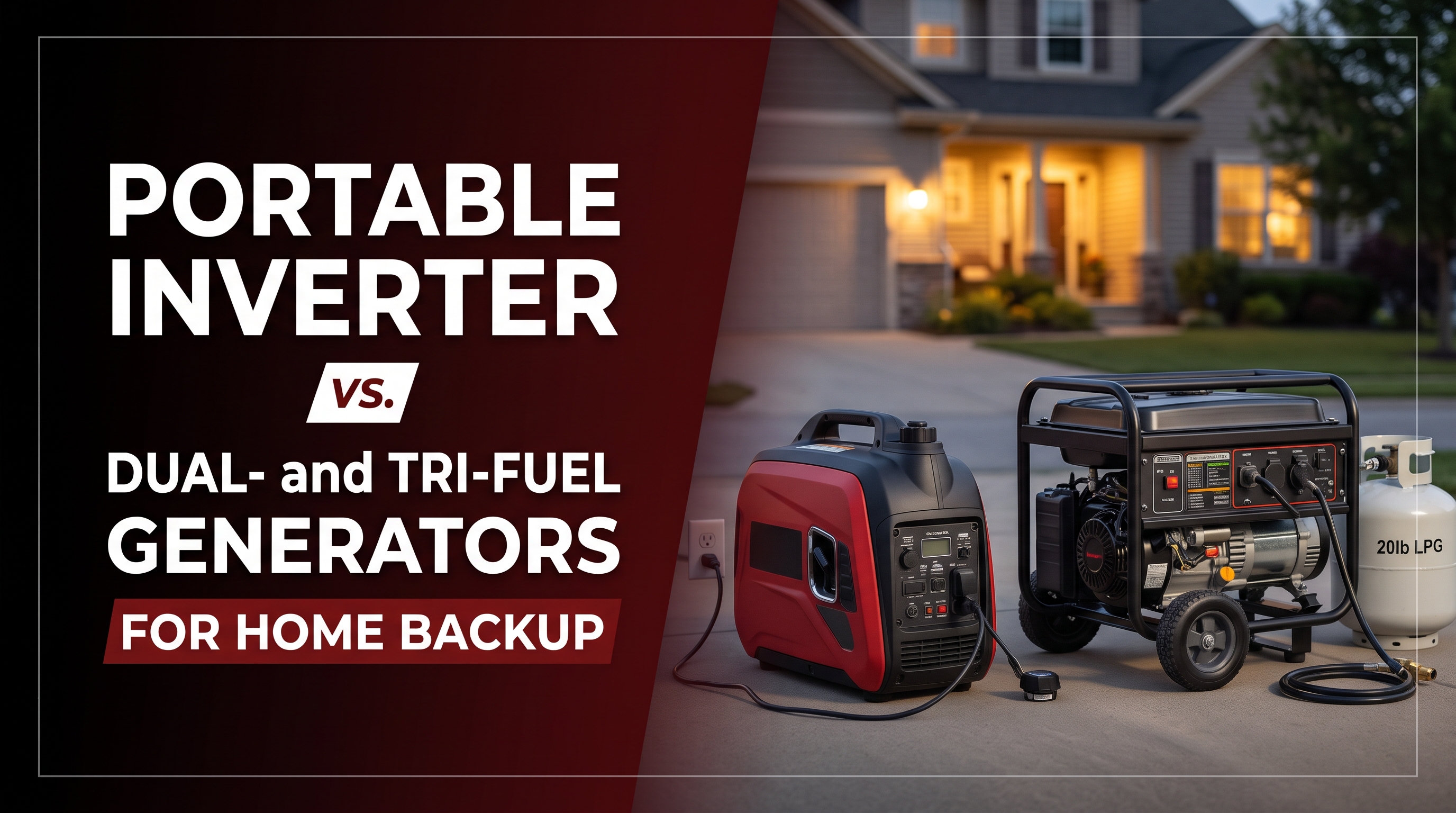
Home Backup Starts With a Plan, Not a Wattage Number
When the power goes out, your priorities might be a refrigerator, a sump pump, a few lights, and a way to charge phones. Another household may need a well pump or more extensive heating and cooling support. The right purchase starts with those needs—not the largest number in a product title.
This home backup generator guide compares portable inverter, dual-fuel, and tri-fuel options, including models that combine those features. It also explains what to check before buying and how to plan a safe connection.
Browse the generators category with your essential-load list in hand. The supplied catalog identifies product types, but detailed manufacturer specifications still need confirmation before you select a unit.
Inverter and Multi-Fuel Describe Different Things
The first distinction is simple: inverter describes electrical-output technology; dual-fuel and tri-fuel describe fuel options. A generator can belong to both groups.
Portable inverter generators
An inverter generator uses electronics to produce its AC output. Some designs can vary engine speed with demand, but operating behavior depends on the model. Buyer tip: Confirm inverter design and variable-speed operation in manufacturer documentation.
For buyers, the relevant questions are output quality, usable continuous power, noise, and fuel consumption at the expected load. Do not assume that every inverter generator is quiet, lightweight, or approved for every electronic device. Buyer tip: Check model-specific sound measurements, weight, total harmonic distortion, and equipment compatibility.
Dual-fuel generators
Dual-fuel equipment offers two fuel choices. Confirm the actual fuels rather than relying on the category label, and check the continuous and starting output for each. Buyer tip: Confirm supported fuels and fuel-specific output ratings.
The practical appeal is having a second fuel plan when your first choice becomes inconvenient. That benefit depends on what you can safely store, transport, and obtain locally.
Tri-fuel generators
Tri-fuel equipment offers three fuel choices, but the exact fuel requirements and connection arrangements remain model-specific. Buyer tip: Confirm supported fuels, required accessories, and connection procedures.
If natural gas is part of your plan, arrange a professional assessment before purchasing. Do not assume an existing outdoor gas connection can supply a generator. Buyer tip: Confirm required gas pressure, flow, pipe sizing, and installation requirements for the selected model.
Size the Generator Around Essential Loads
Separate your outage priorities into three groups:
- Essential: refrigeration, necessary pumps, communications, and selected lights.
- Useful: a microwave, additional outlets, or limited comfort equipment.
- Deferrable: laundry, workshop equipment, and other tasks that can wait.
Your categories may differ. The goal is to avoid paying for simultaneous operation of equipment you would willingly use one at a time.
Build a load worksheet
For each essential appliance, record its voltage, running demand, starting demand where applicable, and connection method. Use appliance labels and manufacturer documentation rather than generic internet estimates.
Add the running loads you expect to use together, then evaluate starting events. Motors and compressors may require additional starting power. Buyer tip: Confirm starting requirements for each appliance and the generator’s surge capability and duration.
For example, suppose your own documented appliance figures total 1,600 running watts, and one appliance requires another 1,000 watts during startup. That creates a hypothetical 2,600-watt starting event—not a universal refrigerator-and-pump sizing recommendation. Multiple starts and other operating conditions still need consideration.
Compare continuous power, voltage, and outlets
Do not treat a headline wattage as guaranteed continuous output. Confirm whether it represents running or starting watts and which fuel was used for the rating. Buyer tip: Check manufacturer rating definitions and fuel-specific output.
Also check voltage and receptacles. A wattage figure alone does not establish compatibility with a well pump, panel inlet, or other planned connection. Buyer tip: Confirm generator voltage, receptacle ratings, and connected-equipment requirements.
If heating or cooling is essential, have an electrician or HVAC professional assess the actual system. Avoid assuming that a portable generator can support central air conditioning or electric resistance heat.
Six Catalog Options to Investigate
These are candidates for different buying priorities, not tested recommendations. Product names establish how the supplied catalog describes them; they do not provide enough detail for a final sizing decision.
Generac 7153 GP3300i Portable Inverter Generator
The Generac 7153 GP3300i Portable Inverter Generator is a starting point for shoppers specifically comparing portable inverter models.
Consider it for an essential-appliance shortlist, then check whether its actual output and connections fit your worksheet. Buyer tip: Confirm continuous and starting watts, voltage, receptacles, fuel requirements, weight, runtime, and output-quality specifications.
Predator 3500 Watt Dual-Fuel Inverter Generator
The Predator 3500 Watt Dual-Fuel Inverter Generator illustrates why inverter and dual-fuel are not opposing choices: the catalog title includes both.
It is worth investigating if you want inverter technology and a second fuel option. Do not interpret “3500 Watt” as continuous power on both fuels or the catalog’s quietness language as a measured comparison. Buyer tip: Confirm supported fuels, running and starting output by fuel, and sound-test conditions.
DuroMax XP5500EH Dual-Fuel Generator
The DuroMax XP5500EH 5,500-Watt Portable Dual Fuel Generator belongs on a fuel-flexibility comparison list.
Compare its documented capabilities with your essential loads rather than assuming the title’s wattage covers every starting event. Buyer tip: Confirm fuel types, continuous output by fuel, voltage, receptacles, starting method, and loaded runtime.
DuroMax XP13000HXT Tri-Fuel Generator
The DuroMax XP13000HXT Tri-Fuel Portable Generator is listed with natural gas, propane, gasoline, electric start, and CO Alert in its catalog title.
Investigate it if your plan includes a professionally assessed natural-gas supply or multiple fuel options. Its headline rating is not a promise of whole-home coverage. Buyer tip: Confirm continuous and starting ratings on each fuel, gas-supply requirements, connection hardware, and CO Alert operation.
GENMAX 11000W Tri-Fuel Inverter Generator
The GENMAX 11000W Tri-Fuel Inverter Generator combines inverter and tri-fuel descriptions in the catalog.
It is a candidate for buyers who want to compare both features in one machine. Before shortlisting it, establish what the headline number represents and whether its connections suit the installation. Buyer tip: Confirm fuel options, output by fuel, voltage, receptacles, output quality, sound levels, and weight.
Bluetti AC200MAX Power Station With Solar Panel
The Bluetti AC200MAX Portable Power Station with 350W Solar Panel offers a battery-based alternative to investigate for selected loads.
Evaluate it separately from combustion generators: battery capacity and recharge opportunities matter alongside AC output. The title’s power figures do not establish overnight runtime. Buyer tip: Confirm usable battery capacity, continuous and surge output, included panel specifications, solar-input limits, operating conditions, and recharge times.
Choose Fuel Around Your Outage Routine
Fuel flexibility is useful only when the fuel is realistically accessible.
For gasoline, consider approved storage, local limits, transportation, and rotation. Follow the equipment manual’s fuel and storage instructions. Buyer tip: Confirm permitted gasoline formulation, storage procedure, and any stabilizer guidance.
For propane, plan cylinder placement, handling, and refill access. Do not assume any cylinder size will support the generator’s full demand in every temperature. Buyer tip: Confirm cylinder sizing, regulator requirements, and cold-weather operating limitations.
For natural gas, include professional gas-line assessment in the purchase decision. Utility service is not an unconditional backup guarantee; ask your provider about local emergency procedures and potential interruptions.
For every fuel, compare runtime only under stated conditions. A runtime figure is incomplete without the load, fuel quantity, and operating mode. Buyer tip: Check manufacturer runtime test conditions.
Decide How Power Will Reach the House
Connection planning should happen before checkout, not during the outage.
For a few plug-in appliances, assess whether suitable generator-rated cords can reach them without creating electrical or trip hazards. Follow the generator and appliance instructions for cord sizing, grounding, moisture protection, and loading. Buyer tip: Confirm model-specific cord and grounding requirements.
For household circuits, use a qualified electrician to specify and install an approved transfer arrangement that prevents connection to utility power. Never feed generator power into a household wall outlet or use a male-to-male cord.
Have the electrician check inlet compatibility, circuit selection, grounding and neutral configuration, permits, and local requirements. Buyer tip: Confirm generator bonding configuration and transfer-equipment compatibility.
Also distinguish portable backup from automatic standby service. Do not assume a portable generator starts itself or transfers household circuits automatically. Buyer tip: Confirm any supported automatic-start and transfer functions.
Make Safe Placement a Purchase Requirement
Operate fuel-burning generators outdoors only, at least 20 feet from the home, with exhaust directed away from doors, windows, and vents. Never run one in a home, basement, garage, shed, or other enclosed or partly enclosed space—even with doors open. Follow any greater manufacturer-required separation. Buyer tip: Confirm model-specific placement and clearance instructions.
Use working carbon monoxide alarms in the home. A generator’s CO shutdown feature does not make unsafe placement acceptable.
Plan for weather without enclosing the generator or restricting exhaust. Buyer tip: Confirm manufacturer-approved wet-weather protection and operating restrictions. Shut the engine down and allow it to cool before refueling, following the manual.
If your property cannot accommodate safe outdoor operation and cord or inlet routing, reconsider a combustion portable rather than improvising a location.
Compare the Complete Ownership Cost
The generator is only one budget line. Allow for the connection equipment, electrician, possible gas work, cords, fuel containers or cylinders, weather protection, maintenance supplies, and storage.
Check the maintenance schedule and your ability to perform it. Buyer tip: Confirm oil-change intervals, inspection requirements, starting-battery care, and storage procedures. Consider who will move, start, connect, and refuel the equipment during bad weather.
The best choice is the one that fits your documented loads, fuel plan, safe operating space, and connection method. Use the generator selection to build a shortlist, then verify the manuals and installation needs before buying.