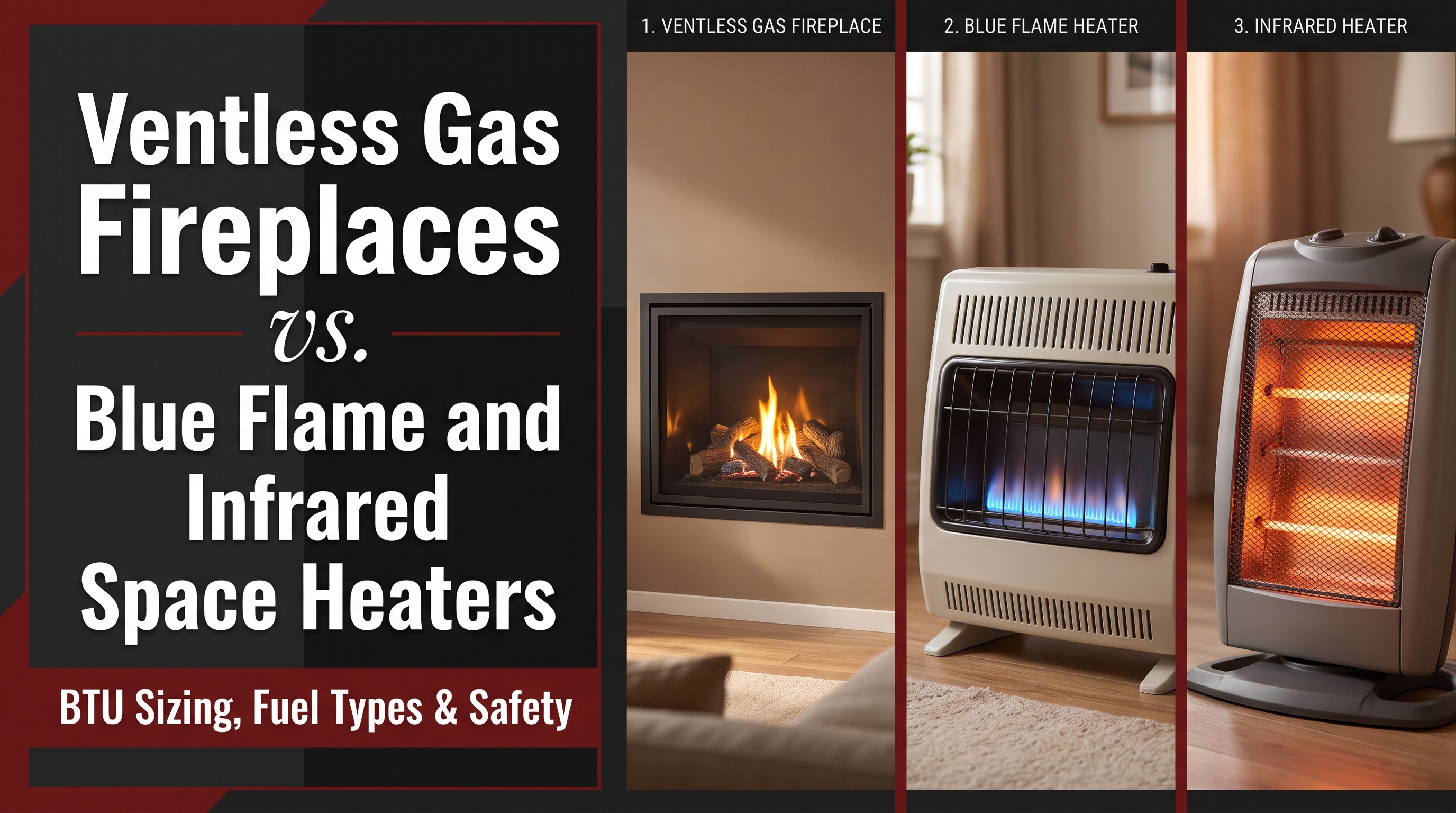
Start With Your Heating Needs, Not Just the BTU Rating
A gas fireplace can add a traditional focal point to a living room, while a compact gas space heater may suit a homeowner looking for supplemental warmth in a frequently used area. But a large BTU rating or an advertised coverage figure does not automatically make one model the best choice for every home.
When comparing a ventless gas fireplace with a blue flame or infrared space heater, start with four questions:
Which room needs additional heat, and how well is it insulated?
Is your available fuel natural gas or liquid propane (LP)?
Do you want a fireplace-style installation, a compact heater or a more direct radiant-heating experience?
Are the specific appliance and its proposed installation permitted by your local codes and the manufacturer's instructions?
This guide compares the main technologies and selected products available through LBRAWEE. The goal is to help you build a practical shortlist without treating manufacturer-rated coverage as a guarantee of real-world performance.
Important: Vent-free does not mean emission-free. Gas combustion can affect indoor air quality. Review the exact owner's manual and local requirements before purchasing, and consider a properly vented alternative when indoor air quality is a concern.
Blue Flame vs. Infrared: What Is the Difference?
Blue flame and infrared heaters use different approaches to delivering heat. Understanding that distinction can help you decide which style deserves a closer look.
Blue flame gas heaters
Blue flame heaters primarily warm the surrounding air through convection. As heated air circulates, the room gradually becomes warmer.
This style may be worth comparing if you want supplemental heat that feels more like conventional room heating. Room layout, air circulation, insulation and the appliance's installation requirements still influence the result.
A blower can help distribute warm air, but it is important to distinguish the gas heater's operation from the blower's electrical requirements. On selected Bluegrass Living models, the heater can operate without electricity while the included blower requires a household electrical supply.
Infrared gas heaters
Infrared heaters deliver radiant heat to people and objects in their path. This can create a more immediate sensation of warmth without relying exclusively on warming all the air in a room first.
Radiant heating may be worth investigating for a space where occupants spend time near the heater. Furniture placement, safe clearances, the room layout and the manufacturer's instructions remain essential.
Ventless gas fireplaces
A ventless gas fireplace combines a fireplace-style appearance with supplemental heating. Depending on the model, features may include a mantel, ceramic logs, thermostat controls, ignition systems and compatibility with more than one fuel type.
For example, the Duluth Forge 32,000 BTU fireplace featured below is described in LBRAWEE's listing as a dual-fuel appliance with thermostat control. The listing also specifies that its optional blower is sold separately.
A fireplace-style appliance is not automatically a better heating choice than a space heater. The installation site, room suitability, local rules and intended use should determine which product you investigate.
The Main Differences at a Glance
Feature
Blue flame heater
Infrared gas heater
Ventless gas fireplace
Main heating approach
Primarily convection
Primarily radiant heat
Depends on burner design
Typical product form
Wall-mounted or freestanding space heater
Wall-mounted or freestanding space heater
Fireplace insert, mantel or stove
Fuel compatibility
Model-specific
Model-specific
Can be single-fuel or dual-fuel
Room suitability
Check room sizing and installation rules
Check room sizing and installation rules
Check room sizing, clearances and installation rules
Main buying consideration
Air circulation and fuel compatibility
Radiant coverage and safe placement
Fireplace dimensions, installation and included components
The table describes general product categories, not a guarantee that a particular appliance is appropriate for your home. Always verify the model-specific details.
- Duluth Forge 32,000 BTU Dual-Fuel Ventless Gas Fireplace
The Duluth Forge fireplace with walnut-finish mantel is worth considering if you want supplemental heat in a fireplace-style package.
LBRAWEE's listing identifies the following features:
Maximum input rating of 32,000 BTU.
Advertised heating coverage of up to 1,500 square feet.
Compatibility with natural gas or liquid propane, as specified for this model.
Thermostat control.
An oxygen-depletion sensor with automatic shut-off.
A fireplace mantel and ceramic-fiber log set.
An optional blower sold separately.
The advertised coverage is a manufacturer/store-listed figure, not a promise that the fireplace will adequately heat every room of that size. Actual heating performance depends on the room, insulation, climate and installation conditions.
Before ordering, confirm the appliance dimensions, mantel dimensions, required clearances, gas connection and whether the optional blower is necessary for your intended installation. The product listing also identifies geographic restrictions, including that the product is not sold to California residents and may be prohibited in other locations.
Buyer tip: A dual-fuel label should not be treated as permission to improvise a fuel conversion. Verify the approved fuel configuration and follow the exact manufacturer's instructions.
- Duluth Forge 26,000 BTU Dual-Fuel Ventless Gas Stove
A stove-style heater offers a different appearance from a fireplace-and-mantel combination. The Duluth Forge 26,000 BTU model listed by LBRAWEE includes remote thermostat control and is advertised for spaces up to 1,200 square feet.
Its listed highlights include:
Maximum input rating of 26,000 BTU.
Natural gas or liquid propane compatibility, subject to the model's approved configuration.
Thermostatic remote control.
A gloss-black finish and stove-style design.
The remote control may be convenient when adjusting the thermostat from across the room. However, convenience features do not remove the need to confirm the appliance's placement, installation requirements and local approval.
Compare its overall dimensions and required clearances with the available space. Also check whether any additional accessories or installation work are required before comparing total project costs.
Buyer tip: Do not purchase based on appearance and BTUs alone. Have the installer verify that the selected model is suitable for the intended room and fuel supply.
- Bluegrass Living 28,000 BTU Propane Infrared Space Heater
The Bluegrass Living B28TPIR-BB is a propane-powered infrared space heater with a thermostat, blower and base feet.
LBRAWEE's product listing identifies:
Maximum input rating of 28,000 BTU.
Liquid propane as the specified fuel.
Infrared radiant heating.
Thermostat control.
An oxygen-depletion sensor with automatic shut-off.
Included blower and base feet.
Wall-mounting and floor-placement hardware, subject to the manufacturer's installation instructions.
The listing advertises coverage in the approximate range of 1,400–1,450 square feet in different parts of the product description. Verify the exact coverage specification against the current owner's manual before publication or purchase.
The listing also states that the blower requires a standard 120-volt household supply, while the heater can operate without the blower if electricity is unavailable. Verify these operating conditions in the exact manual before relying on the product during an outage.
This is a propane-only listing. Do not assume it can operate on natural gas.
Buyer tip: Compare the radiant heating approach with your room layout and intended seating areas, but never position the appliance based solely on where you want to feel the heat. Required clearances and placement instructions take priority.
- Bluegrass Living 20,000 BTU Propane Blue Flame Space Heater
If you prefer a convection-oriented heater, the Bluegrass Living B20TPB-BB offers another configuration to compare.
LBRAWEE lists the following features:
Maximum input rating of 20,000 BTU.
Liquid propane fuel.
Advertised heating coverage of up to 950 square feet.
Thermostat control.
An oxygen-depletion sensor with automatic shut-off.
An included blower and base feet.
The product listing describes the blue flame design as primarily heating the air in the room. As with the infrared option, the listed coverage is not a guarantee of performance in every home.
When comparing these two Bluegrass Living models, do not assume that a higher BTU rating automatically means a better purchase. The room, fuel availability, heating pattern, approved installation and operating requirements all matter.
Buyer tip: Confirm the heater's installation location, fuel supply, electrical needs for the blower, minimum clearances and any ventilation requirements in the owner's manual.
How to Size a Gas Heater for Your Room
BTU stands for British thermal unit and describes a quantity of heat. A heater's BTU input rating is only one part of selecting the right appliance.
The products above advertise different maximum heating outputs and room-coverage figures. Those numbers should be treated as starting points for comparison, not as a universal sizing formula.
Before selecting a model, consider:
Room dimensions: Measure the length, width and ceiling height. An open-plan area may behave differently from a closed room of the same floor area.
Insulation and drafts: Older windows, poor insulation and air leakage can affect how quickly heat is lost.
Climate: A room's heating needs depend partly on outdoor conditions and the indoor temperature you want to maintain.
Existing heating: Determine whether the appliance is intended only to supplement an existing system or to serve another approved purpose.
Manufacturer requirements: Check the minimum room volume, permitted installation locations, clearances and any ventilation requirements for the exact model.
Local rules: Confirm that this category of appliance is legally permitted where you live and that the proposed installation complies with applicable codes.
Avoid choosing an appliance solely because its advertised square footage matches the measured floor area. A qualified installer can help assess whether the proposed capacity and configuration fit the actual space.
Natural Gas vs. Liquid Propane: Choose the Correct Fuel
Fuel compatibility can narrow your shortlist before you compare appearance or price.
Natural gas
A natural-gas appliance must be compatible with the home's gas supply and installed according to its instructions. Confirm the correct model and any service requirements with a qualified professional.
Liquid propane
Propane appliances require the appropriate propane supply and approved connections. A propane-only heater should not be treated as interchangeable with a natural-gas model.
Dual-fuel models
The Duluth Forge fireplace and stove featured in this article are listed as dual-fuel appliances. That flexibility can be helpful for households comparing available fuel options, but the approved configuration and setup must still follow the manufacturer's documentation.
Before buying, confirm the exact product model, intended fuel, connection requirements, any required accessories and the installation cost. Never assume that a retailer's general description authorizes a conversion or connection procedure.
Important Safety Checks Before Buying a Ventless Gas Heater
A ventless gas fireplace or space heater is a combustion appliance. Its purchase decision should include indoor air quality, not just heat output and aesthetics.
The U.S. Environmental Protection Agency identifies unvented gas space heaters and other combustion appliances as potential sources of indoor pollutants, including carbon monoxide, nitrogen dioxide and particles. The EPA also explains that nitrogen dioxide can affect the respiratory system and that indoor levels may be higher in homes using unvented gas appliances.
Read the EPA's guidance on nitrogen dioxide and indoor air quality and sources of combustion products before making a purchase decision.
What does an oxygen-depletion sensor do?
Some products in this guide include an oxygen-depletion sensor (ODS) with automatic shut-off. This is a model-specific safety feature, but it should not be treated as a complete indoor-air monitoring system.
An ODS is not a substitute for a carbon-monoxide alarm, correct installation, maintenance, compliance with local requirements or following the manufacturer's operating instructions.
Review the U.S. Consumer Product Safety Commission's indoor-air-quality guidance and the CDC's carbon-monoxide safety information.
Verify clearances and approved locations
Maintain the clearances specified by the manufacturer around walls, furniture, curtains, combustible materials and other objects. Do not invent a clearance distance based on the heater's dimensions or a generic online recommendation.
Also confirm whether the exact model is approved for the proposed room. Do not assume that bedroom, bathroom or other enclosed-space installation is permitted simply because an appliance is described as ventless.
Where required, arrange installation and inspection by a qualified professional. If the product's instructions and applicable local rules do not clearly support the proposed use, choose another heating solution.
Check geographic restrictions and altitude limits
Some products carry specific geographic restrictions. LBRAWEE's listings for the featured vent-free models state that the appliances are not sold to California residents and may be prohibited in other locations.
The listings also state an altitude limitation of 4,500 feet for vent-free heaters. Confirm the exact limitation and suitability for your location in the current owner's manual.
Local regulations vary, so check the rules that apply to your property before ordering.
Which Heating Option Should You Shortlist?
Use these comparisons to organize your decision rather than treating any product as a universal winner.
Choose the fireplace-style route for further investigation if you want a built-in-looking focal point and the exact fireplace is permitted for your room and location. Compare the Duluth Forge 32,000 BTU fireplace.
Compare the stove configuration if its dimensions, appearance, thermostat controls and approved installation better suit your space. Review the Duluth Forge 26,000 BTU stove.
Investigate infrared heating if radiant warmth is your priority and the propane configuration and proposed installation are suitable. Review the Bluegrass Living 28,000 BTU infrared heater.
Compare blue flame heating if you are evaluating a convection-oriented space heater and the model's output, fuel and installation requirements match your needs. Review the Bluegrass Living 20,000 BTU blue flame heater.
Before placing an order, compare the current product price, included accessories, delivery details, installation requirements, warranty and return conditions.
If indoor combustion emissions are a concern, investigate an appropriately sized electric heater or a properly vented heating appliance instead of assuming a ventless model is the best choice.
Frequently Asked Questions
Is a ventless gas fireplace the same as a ventless space heater?
They are both combustion appliances, but they can differ in physical design, burner type, controls, intended application and installation requirements. A fireplace-style appliance may include a mantel and decorative logs, while a space heater is designed primarily for supplemental room heating. Compare the exact specifications rather than assuming the products are interchangeable.
Is blue flame better than infrared?
Neither is universally better. Blue flame heaters primarily warm the room air through convection, while infrared heaters primarily transfer radiant heat to people and objects. The best category to investigate depends on the room, how it is used, the approved installation and your heating preferences.
Does a higher BTU rating mean the heater is better?
No. A higher BTU rating describes a higher maximum heat-input rating, not guaranteed comfort or suitability. Room size, insulation, local climate, heater placement and the manufacturer's requirements all influence the selection.
Can a dual-fuel fireplace use both natural gas and propane?
Only when the exact appliance is designed and approved for the applicable fuel configuration. Confirm the manufacturer's instructions and have the connection or setup handled by a qualified professional as required.
Can a ventless heater be used during a power outage?
Some models do not require electricity for their basic heating function, but accessories such as blowers may require a household electrical supply. Verify the precise operating requirements in the owner's manual. Never improvise a substitute heating method or ignore required safety procedures during an outage.
Should I buy a ventless heater for a bedroom?
Do not make that decision from a generic article or product category. Verify the exact model's approval and restrictions, check applicable local codes and consult a qualified professional. Consider a properly vented alternative where indoor air quality is a concern.
Final Buying Checklist
Before choosing a gas fireplace or space heater, confirm the following:
The exact model is permitted in your location and suitable for the proposed room.
Its fuel type matches your approved supply and configuration.
Its BTU rating and manufacturer-rated coverage are appropriate starting points for a properly assessed space.
You have checked the owner's manual for clearances, room requirements, installation rules and maintenance.
Included and optional components are clearly understood, including any blower or installation accessories.
Indoor-air-quality precautions and carbon-monoxide safety measures are addressed.
The total project budget includes delivery, installation and any required professional work.
Ready to compare your options? Explore the LBRAWEE Home Deals collection and review the exact specifications before choosing a heating product.
1. Duluth Forge Dual Fuel Ventless Fireplace
For living rooms up to 1,500 sq. ft., the Duluth Forge Dual Fuel Ventless Fireplace provides 32,000 BTU of supplemental heat...
Complete Space Heater & Stove Directory
| Brand & Model | Type / Fuel | BTU / Rating | Shop Link |
|---|---|---|---|
| ProCom Reconditioned Dual Fuel MNSD3TPA-R | Infrared Ventless | 20,000 BTU | View Model |
| Bluegrass Living B20TNB-BB | Blue Flame (NG) | 20,000 BTU | View Model |
| A.O. Smith Signature 100 50-Gal Gas | Tall Tank (NG) | 40,000 BTU | View Model |
| Navien NPE-240S | Condensing Tankless | Up to 11.2 GPM | View Model |
Browse All 64 Heating & Fireplaces Deals
Editorial note: This article is a general buying guide, not an installation manual or a guarantee that any appliance is suitable for a particular property. Follow the current manufacturer instructions and applicable local requirements.
FURTHER READING
U.S. EPA — Nitrogen Dioxide's Impact on Indoor Air Quality
U.S. EPA — Sources of Combustion Products
U.S. Consumer Product Safety Commission — The Inside Story: A Guide to Indoor Air Quality
CDC — Carbon Monoxide Poisoning Basics
LBRAWEE — Home Deals