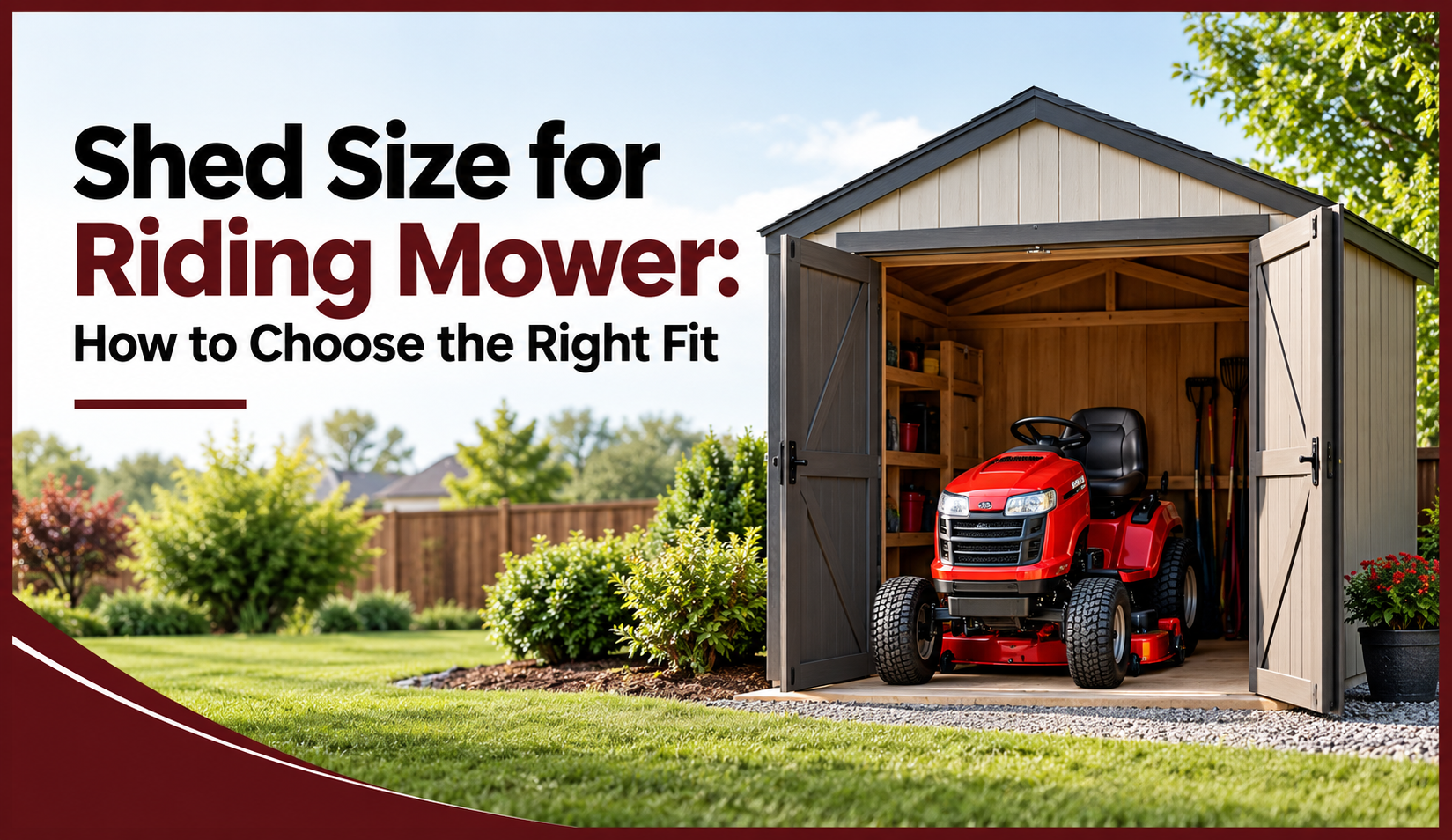
Choosing the right shed size for a riding mower starts with four things: your mower's overall dimensions, the shed's actual interior space, the clear doorway opening, and the room you need to maneuver safely.
A shed that looks large enough on paper can still be difficult to use if the doorway is too narrow, the mower's discharge chute catches on the frame, or there is no room to walk around the parked machine.
For many homeowners storing one standard riding mower, a 10×12-foot shed is a practical starting point. An 8×10-foot shed may work when space is limited and the layout is carefully planned, while a 12×12- or 12×16-foot shed offers more flexibility for tools, attachments, and maintenance access.
These are planning guidelines, not guaranteed fits. The right dimensions depend on your particular mower and the shed model you choose.

Image source: Homemade lawn mower shed on Wikimedia Commons.
What Shed Size Is Right for a Riding Mower?
The best shed size depends on whether you need storage for the mower alone or want room for other lawn-care equipment.
Start with the following comparison to narrow your choices.
| Nominal shed size | Floor area | Best suited for | Main consideration |
|---|---|---|---|
| 8×10 ft | 80 sq. ft. | One compact riding mower with limited additional storage | Tight clearance; doorway placement and mower dimensions are critical |
| 10×12 ft | 120 sq. ft. | One standard riding mower with some room for tools | A practical starting point for balancing footprint and access |
| 12×12 ft | 144 sq. ft. | One riding mower, wall-mounted tools, and additional walking space | More flexibility for everyday access |
| 12×16 ft | 192 sq. ft. | Larger mowers, attachments, shelving, and additional equipment | A larger footprint and foundation may be required |
These are preliminary planning examples based on nominal dimensions. Actual interior measurements and the clear doorway opening vary by shed model.
Is an 8×10 shed big enough?
An 8×10 shed can be enough for a compact riding mower if its overall length and width fit the usable interior and the doorway provides sufficient clearance.
However, the space can become restrictive once you account for the door frame, wall thickness, storage shelves, and room to get on or off the machine.
Choose this size only after confirming the measurements and sketching the proposed layout. It is less suitable if you also need to store a cart, large tool cabinets, or several bulky attachments.
Is a 10×12 shed a good starting point?
For many homeowners with one standard riding mower, a 10×12 shed offers a useful balance of space and cost.
Depending on the mower and doorway configuration, it may accommodate the mower, a few wall-mounted tools, and room to approach the machine without constantly moving other items.
Check the interior dimensions rather than assuming the full nominal footprint is usable. If you plan to maintain the mower indoors or store bulky seasonal equipment, consider a larger footprint.
When should you choose a 12×12 or 12×16 shed?
Consider a larger shed when you have:
- A wide-deck riding mower or zero-turn mower.
- A grass collection system, bagger, trailer, or other attachments.
- A garden cart, leaf blower, trimmer, or snow blower.
- Shelving or a workbench that cannot obstruct the mower's route.
- A need for more room to access the mower for routine maintenance.
The additional space is especially useful when you want a storage area that remains organized as you add equipment.
Browse your available storage shed options and compare each model's usable interior dimensions before choosing a footprint.
What Measurements Should You Take Before Choosing a Shed?
The most reliable way to select a shed is to measure the equipment you already own before comparing products.
Do not rely on cutting-deck size alone. The advertised deck width is not necessarily the mower's total width, and accessories can increase its overall dimensions.
1. Measure the mower's overall width
Measure the widest point of the mower in the configuration you will use when entering the shed.
Include:
- The cutting deck.
- The discharge chute or deflector in its normal storage position.
- Any installed bagger, side attachment, or other accessory that affects width.
A chute that extends beyond the deck can be the deciding factor when comparing a mower with a shed doorway.
For context, John Deere's S120 specifications identify a 42-inch cutting width. That figure describes the cutting system, not a universal doorway requirement. Measure the complete machine you intend to store.
2. Measure the overall length
Measure from the foremost point to the rearmost point of the mower, including any installed rear attachment.
Allow for the space needed to approach the seat and move around the machine. A mower that fits with its front bumper almost touching the wall may be technically storable but inconvenient to use.
3. Measure the overall height
Measure from the ground to the highest point of the mower in its intended storage configuration.
Account for the seat, steering wheel, attachments, or rollover protection structure where applicable. If you plan to drive into the shed while seated, check the height of the operator and any structure above the seat as well as the machine itself.
4. Measure the route into the shed
The shed is only one part of the fit calculation.
Measure the narrowest points along the path from your parking or mowing area to the shed, including:
- Garden gates and side-yard passages.
- Fences, posts, and nearby walls.
- Tight turns near the entrance.
- The ramp and threshold area.
- Any sloping ground or obstacles that affect steering.
A mower may fit through the shed door but still be difficult to maneuver into position.
5. Check the shed's actual dimensions
Before ordering, find the manufacturer's stated:
- Interior width and depth.
- Clear doorway width.
- Clear doorway height.
- Door position and swing.
- Floor or threshold height.
- Floor load rating, if applicable.
Nominal shed dimensions often describe the exterior footprint. Wall thickness, framing, door hardware, and structural supports can reduce the available space.
The key is to compare the mower's measurements with the usable dimensions of the specific shed, not just the product name.
How Much Room Do You Want Around the Mower?
A shed should do more than hold the mower. It should let you park, get off, retrieve tools, and leave without repeatedly rearranging everything inside.
As a starting point, plan for approximately 24–36 inches of walking and working space on at least one side of the parked mower. Depending on the layout, you may need additional room at the front or rear to move around it, reach stored equipment, or perform maintenance.
These are practical planning allowances rather than universal requirements. Your layout and access needs should determine the final dimensions.
Plan around three types of space
Parking space: The complete mower footprint, including installed accessories.
Access space: The room required to approach the seat, step off, open storage compartments, and walk past the machine.
Storage space: The area needed for tools, bins, shelves, chargers, or attachments.
For example, an illustrative layout for a 10×12 shed could place the mower near the center, store hand tools on one wall, and leave a clear route to the doorway. Whether this works depends on the actual mower dimensions, door opening, and usable interior.
Avoid planning storage right where the mower needs to turn or where you need to walk to reach the exit.
Decide what belongs inside
Before choosing between a compact and larger shed, write down everything you want to store.
| Equipment | Planning consideration |
|---|---|
| Riding mower | Measure the complete machine |
| Grass collector or bagger | Account for installed width or separate storage |
| Garden cart | Allow room to park and move it |
| Trimmer and leaf blower | Wall hooks or vertical storage may save floor space |
| Shelving or tool cabinet | Include the shelf depth in your layout |
| Workbench | Preserve a usable walkway and maintenance area |
| Snow blower or additional mower | Consider a larger shed or a separate storage zone |
A simple scaled sketch can reveal space conflicts before you spend money on a shed.
Will the Mower Fit Through the Doorway With Its Attachments Installed?
This is one of the most important checks when determining the right shed size for a riding mower.
A spacious interior cannot compensate for an entrance that is too narrow or too low. The mower must pass through the actual clear opening without striking the frame or nearby obstacles.
Calculate the minimum doorway width
Use this simple planning formula:
Required clear doorway width = mower's widest overall width + clearance allowance
As a practical starting point, add 6–12 inches to the measured width, providing approximately 3–6 inches of total clearance on each side when centered. More space can make entry easier, especially if your approach is angled or your steering area is restricted.
Example:
Suppose your mower measures 56 inches wide at its widest point.
- Mower width: 56 inches.
- Illustrative total clearance: 12 inches.
- Target clear doorway width: 68 inches.
A doorway with a genuine clear width of approximately 68 inches would provide the planned clearance in this example. It is not a universal minimum; a different mower or approach may require more.
Measure the clear opening, not the advertised door size
The listed door size may differ from the space available when the door is fully open.
Check for:
- Door leaves that do not open completely.
- Hinges or handles that protrude into the opening.
- A center post between double doors.
- Door stops, trim, and framing.
- A raised threshold that narrows the usable route.
When possible, use the manufacturer's documented clear opening width and height.
Check attachments before ordering
If you normally store the mower with its grass collector, side discharge chute, or other equipment installed, take those components into account.
You may be able to remove or reposition certain attachments for storage, but only do so when the equipment manufacturer's instructions permit it and the arrangement is practical for everyday use.
Also confirm the entrance height if the mower has a tall seat, rollover protection structure, or other elevated components.
For a tight doorway, a larger double-door or roll-up-door configuration may be worth comparing. Verify that the selected shed model actually provides the required clear opening.
What Foundation, Floor, and Ramp Requirements Should You Confirm?
A suitable shed needs a stable base, a floor that supports the mower, and an entrance that the machine can travel over safely.
These considerations are just as important as the shed's length and width.
Foundation and drainage
The foundation should be level, stable, and appropriate for the shed's design and expected loads.
Depending on the product and site, possible bases include a prepared gravel pad, a suitable timber platform, or a concrete slab. Follow the shed manufacturer's requirements rather than assuming every foundation type is compatible with every shed.
Before installation:
- Choose a location with good drainage.
- Prepare a level base that supports the entire shed.
- Confirm whether the shed requires a foundation frame.
- Check anchoring requirements for the structure and site.
- Review local building permits, placement restrictions, and setback requirements.
Home Depot's guide to preparing a resin shed installation area discusses leveling the site and selecting an appropriate foundation.
Floor strength and load capacity
A riding mower is substantially heavier than many hand tools, and the load is concentrated around its wheels.
Check whether the shed floor is designed to support the mower's weight and rolling loads. If the manufacturer does not specify a suitable capacity, obtain confirmation before purchasing.
Consider the following:
- Whether the floor is included or sold separately.
- Whether the structure needs a dedicated floor frame.
- Whether the flooring is suitable for repeated wheel traffic.
- Whether moisture-resistant materials are appropriate for your site.
- Whether additional equipment will increase the total load.
A concrete slab may provide a durable surface when correctly designed and installed. A timber or proprietary shed floor can also work when it meets the manufacturer's specifications.
Do not assume that a shed advertised for general storage is automatically suitable for a riding mower.
Ramp dimensions and traction
If the shed floor is above ground level, you will need a suitable way to move the mower over the threshold.
A ramp should be designed for the machine's weight and wheel configuration. Its length depends on the height difference and the slope that can be used safely.
Before choosing a ramp, verify:
- The vertical rise from the ground to the shed floor.
- The ramp's rated load capacity.
- The width needed for the mower's wheels and deck.
- Traction in wet conditions.
- Secure attachment and support.
- Adequate clearance at the top and bottom.
A short, steep ramp can be difficult to climb or descend, particularly when steering or reversing. Do not select ramp length based on convenience alone.
Also check that the doorway, threshold, and ramp align so that the mower does not catch its deck or attachments as it enters.
Follow the mower manufacturer's storage and fuel-safety instructions, including any guidance on cooling the engine and handling gasoline before storing the machine.
Riding Mower Shed Measurement Worksheet
Use this worksheet before comparing shed products. Fill it in with your own measurements rather than relying on advertised mower class or deck width.
Step 1: Measure the mower
| Measurement | Your measurement |
|---|---|
| Overall width, including installed attachments | ______ inches |
| Overall length | ______ inches |
| Overall height in storage configuration | ______ inches |
| Widest point with chute or accessories in position | ______ inches |
| Height needed if entering while seated | ______ inches |
| Total mower weight | ______ lb |
Use the machine manual or manufacturer specifications to verify dimensions and weight where possible.
Step 2: Set your clearance targets
| Planning item | Your target |
|---|---|
| Extra clear doorway width beyond mower width | ______ inches |
| Desired walking space on one side | ______ inches |
| Front clearance | ______ inches |
| Rear clearance | ______ inches |
| Space reserved for tools and equipment | ______ sq. ft. |
These clearances are for planning your layout. Increase them as needed for comfortable access or maintenance.
Step 3: Check the shed
| Shed specification | Product measurement |
|---|---|
| Nominal exterior width | ______ feet |
| Nominal exterior depth | ______ feet |
| Usable interior width | ______ inches |
| Usable interior depth | ______ inches |
| Actual clear doorway width | ______ inches |
| Actual clear doorway height | ______ inches |
| Floor load capacity verified | Yes / No |
| Foundation requirements confirmed | Yes / No |
| Ramp requirements confirmed | Yes / No |
Step 4: Test your layout
Before placing an order, confirm all four conditions:
- [ ] The mower fits within the usable interior dimensions.
- [ ] The mower clears the doorway with the intended attachments installed.
- [ ] There is enough room to enter, park, exit, and access stored tools.
- [ ] The foundation, floor, threshold, and ramp are suitable for the mower.
If any check fails, compare another shed size or configuration before buying.
Common Mistakes When Choosing a Shed for a Riding Mower
Avoid these mistakes when comparing storage options.
Choosing by deck width alone. A 42-inch or 54-inch cutting deck does not tell you the complete width of the machine.
Ignoring the doorway. Measure the clear opening, not just the nominal shed width or door size.
Forgetting accessories. A grass collector or other installed equipment can change the space required.
Using exterior dimensions as interior dimensions. Wall thickness, framing, and supports reduce usable space.
Leaving no room to walk. A mower may fit on the floor while making the shed inconvenient to use.
Overlooking the approach. Gates, turns, ramps, and thresholds can make entry difficult even if the doorway itself is wide enough.
Assuming the floor is strong enough. Verify the manufacturer's load specifications before storing heavy machinery.
Forgetting future storage needs. If you expect to add a cart, snow blower, shelving, or other equipment, include that space in the initial plan.
Frequently Asked Questions
What is the smallest shed size for a riding mower?
An 8×10 shed can work for some compact riding mowers, but it offers limited flexibility. Check the mower's complete dimensions, the clear doorway opening, and the interior layout before committing to this size.
Is a 10×12 shed big enough for a riding mower?
A 10×12 shed is a useful starting point for many standard riding mowers and may leave room for small tools. The actual fit depends on the mower, the doorway, the interior dimensions, and the amount of additional equipment you need to store.
How wide should a shed door be for a riding mower?
Measure the mower at its widest point with the attachments in the intended storage configuration. As an initial planning allowance, add 6–12 inches to that measurement, then verify the actual opening width and the turning approach. Larger equipment or awkward entrances may require more clearance.
Can I store a zero-turn mower in a standard garden shed?
Some zero-turn mowers can fit in standard shed footprints, but wider decks and larger frames may require a wider entrance and more interior space. Compare your mower's overall dimensions with the specific shed's clear opening and usable floor area.
Do I need a concrete foundation?
Not necessarily. The correct base depends on the shed's design, the manufacturer's instructions, site drainage, local requirements, and the expected load. Choose a foundation that supports the structure and mower safely.
Should I buy a larger shed than I need today?
Extra space can be worthwhile if you expect to add equipment or want room for maintenance. Compare the additional cost and footprint with your realistic storage plans. A larger shed is useful only if it also has the right access, layout, and foundation.
Find the Right Shed for Your Riding Mower
The best shed is the one that fits your mower through the doorway, accommodates it inside, provides enough space for everyday access, and has the correct floor and foundation for your equipment.
Measure first, compare actual product specifications, and leave room for the way you use your mower. A little planning now can prevent an expensive fit problem later.
Sources: