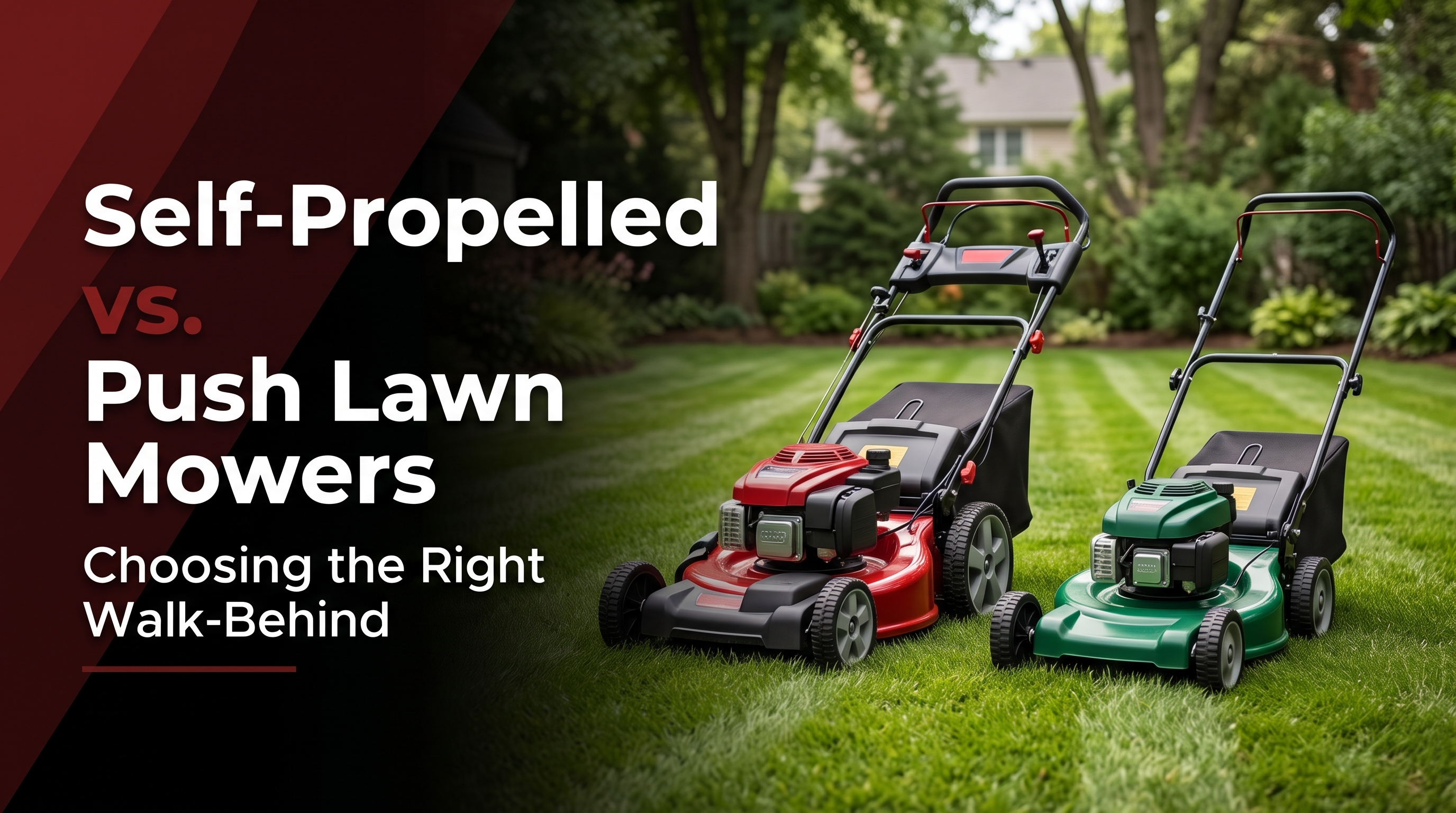
Self-Propelled or Push: Start With Your Mowing Routine
Choosing between a self-propelled and push mower comes down to a practical question: how much help do you want moving the machine around your yard?
A push mower relies on you to move it forward. A self-propelled mower uses a powered drive system to help move its wheels while you guide it. Both still require an attentive operator, and neither design automatically delivers a better-looking lawn.
The self propelled vs push mower decision is easier when you look beyond acreage. Slopes, tight corners, storage access, and your comfort during a complete mowing session all matter. A small yard with an incline can call for a different mower than a larger, flat rectangle.
This guide compares the trade-offs and highlights four catalog options to investigate. You can also browse the walk-behind mowers category as you build your shortlist.
What Is the Difference?
Push mowers: you provide the forward motion
Here, “push mower” means a powered lawn mower without powered wheel assistance—not a manual reel mower. Its motor or engine powers the cutting system, while you supply the force that moves the machine across the lawn.
That arrangement may suit someone with a manageable, mostly level yard who prefers direct control over their walking pace. It also avoids a powered wheel-drive system as another component to operate and maintain.
However, do not assume every push mower is lightweight or easy to maneuver. Compare actual machine weight, handle fit, wheel design, and how the mower must travel between storage and the lawn.
Self-propelled mowers: powered assistance while you steer
A self-propelled mower helps with forward travel. You still steer, negotiate obstacles, manage turns, and operate its controls.
The appeal is reduced pushing effort during mowing, especially when repeated passes become tiring. The trade-off is a drive system whose feel, speed adjustment, and maintenance requirements deserve attention.
Control behavior varies by model. Before buying, confirm how the drive engages, how speed is adjusted, and what happens when you release the controls. Buyer tip: Consult the selected mower’s operator manual for drive and safety-control operation.
Match the Mower to Your Yard
Flat, open lawns
For a mostly level lawn with straightforward access, a push mower is worth considering. Ask whether you can comfortably move it through the entire job—not just across a short patch near the driveway.
Self-propulsion can still be useful on flat ground. If your mowing route involves long, repeated passes, powered assistance may be more important to you than minimizing mechanical complexity.
There is no universal acreage cutoff between these designs. Your pace, lawn layout, and tolerance for physical effort matter alongside the amount of grass.
Slopes and uneven ground
Self-propulsion can help with the effort of moving a mower, but it is not permission to mow a steep or unstable area. Traction, footing, and the manufacturer’s operating restrictions remain critical.
Check the operator manual for slope limits and the prescribed mowing direction before using any candidate on an incline. Buyer tip: Slope restrictions and slope-mowing instructions are model-specific.
If part of your property feels unsafe to walk while controlling equipment, do not try to solve that problem simply by choosing a stronger drive system. Consider a different maintenance approach for that area.
Trees, beds, gates, and narrow passages
A yard with many obstacles puts a premium on maneuverability. Think about how often you stop, turn, reposition, or pass through a narrow opening.
A wider cutting path can reduce the number of passes across an open section, but width alone does not tell you whether a mower will fit your route. Measure your narrowest gate and storage doorway, then compare those measurements with the mower’s overall dimensions—not only its advertised cutting width. Buyer tip: Confirm overall dimensions in manufacturer documentation.
For self-propelled models, check the instructions for disengaging the drive and repositioning the mower. Buyer tip: Drive disengagement and manual-movement procedures vary by model.
Choose the Power Source Separately
Push versus self-propelled describes how the mower moves. Gas versus battery describes its power source. Treat these as two separate decisions rather than assuming one automatically determines the other.
Battery-powered considerations
For a battery mower, establish exactly what comes in the package. A product name may mention batteries or a charger, but the selected configuration needs confirmation.
Check included battery quantities and capacities, charger details, battery compatibility, and any documented runtime conditions. Buyer tip: Package contents, compatibility, and runtime must be confirmed for the exact model and configuration.
Plan where charging will happen and whether you are comfortable pausing if the available charge does not cover your mowing session. Do not infer lawn coverage from voltage alone.
Gas-powered considerations
For a gas mower, consider fuel handling, engine care, and seasonal storage along with the mowing experience. Use the manufacturer’s specified fuel, oil, service schedule, and storage procedures. Buyer tip: Engine maintenance and storage requirements depend on the exact mower and engine.
Engine displacement is not a stand-alone measure of cut quality or ease of use. A larger number does not answer whether the mower fits your gates, turns comfortably, or suits your maintenance preferences.
Four Walk-Behind Mowers to Compare
These options represent different approaches, not a tested ranking. The supplied catalog includes product names but no detailed specification sheets, so confirm the marked details before making a purchase.
A push-mower option: 40V 16 in Brushless Cordless Push Lawn Mower
The 40V 16 in Brushless Cordless Push Lawn Mower 2x 4.0Ah Batteries Charger is the push-style candidate in this comparison.
Consider it if your priority is a battery-powered mower without powered wheel assistance. Its catalog name identifies a narrower nominal cutting width than the self-propelled options below, making it worth examining for a yard with confined sections.
Before choosing it, verify the cutting width, assembled weight, overall dimensions, and whether the package includes two 4.0Ah batteries and a charger. Buyer tip: Confirm specifications and package contents against the exact manufacturer model.
The key question is whether you can comfortably push it for your full route—not simply whether its deck sounds compact.
A battery self-propelled option: EGO POWER+ Select Cut XP
The EGO POWER+ 21-Inch Select Cut XP Self-Propelled Lawn Mower with Touch Drive — 56V ARC Lithium is a candidate for shoppers who want battery power with wheel-drive assistance.
Compare it with the push option if physical effort is your main concern but you prefer a battery-based mowing routine.
Confirm the exact model number, included battery and charger, cutting width, and Touch Drive operating instructions. Buyer tip: Catalog naming does not establish the complete configuration or control behavior.
Do not assume that the voltage or Select Cut XP name establishes runtime, coverage, or results in your grass. Those questions require configuration-specific documentation and realistic expectations about your lawn.
A wider gas option: Troy-Bilt TBWC28T
The Troy-Bilt TBWC28T 28-Inch 3-in-1 Self-Propelled RWD Gas Lawn Mower — 195cc OHV, InStep Variable Speed is worth investigating for an open lawn where a wider cutting path is appealing.
Its catalog name identifies rear-wheel drive and variable speed. Confirm those features, the cutting width, engine specification, and supported clipping-management modes before relying on them. Buyer tip: Check the TBWC28T manufacturer documentation and included accessories.
Give equal attention to overall width, machine weight, and turning space. A mower that suits long straight passes may still be awkward beside closely spaced beds or inside a crowded shed.
Another wide-cut candidate: Toro TimeMaster 21199
The Toro TimeMaster 21199 30 in. 223 cc Gas Self-Propelled Lawn Mower offers another catalog option for shoppers comparing wider self-propelled gas designs.
Investigate it if you have substantial open mowing areas and storage access that can accommodate the machine. Confirm its cutting width, overall dimensions, weight, engine details, and drive-control operation. Buyer tip: Check manufacturer documentation for model 21199.
Do not translate the listed width into a promised time saving. Overlap, turns, obstacles, walking pace, and clipping handling all affect how long the job takes.
What to Check Before You Buy
Use the same checklist for every candidate:
- Your route: Measure gates, doorways, and tight passages; identify slopes and awkward turns.
- Physical handling: Consider pushing, steering, repositioning, and moving the mower into storage.
- Controls: Confirm that drive engagement and speed adjustment suit your needs.
- Clipping preferences: Verify mulching, bagging, or discharge capabilities and any required accessories. Buyer tip: Supported modes and included accessories vary by model.
- Storage: Confirm dimensions and approved storage orientation. Do not assume a mower can stand vertically. Buyer tip: Consult manufacturer storage instructions.
- Ownership costs: Compare the complete package, maintenance items, replacement batteries where applicable, and service access—not just the initial price.
If possible, review the operator manual before ordering. It can answer practical questions that a short product title cannot.
The Bottom Line
Choose a push mower when you are comfortable supplying the forward effort and the machine fits your lawn, access points, and storage routine.
Choose a self-propelled mower when powered travel assistance would make the job more manageable. Then compare control feel, dimensions, power source, and upkeep rather than assuming every self-propelled model is equally suitable.
Start with your yard’s constraints, shortlist two or three options, and verify their exact configurations. Explore the walk-behind mower selection to find a mower that fits how you actually mow.