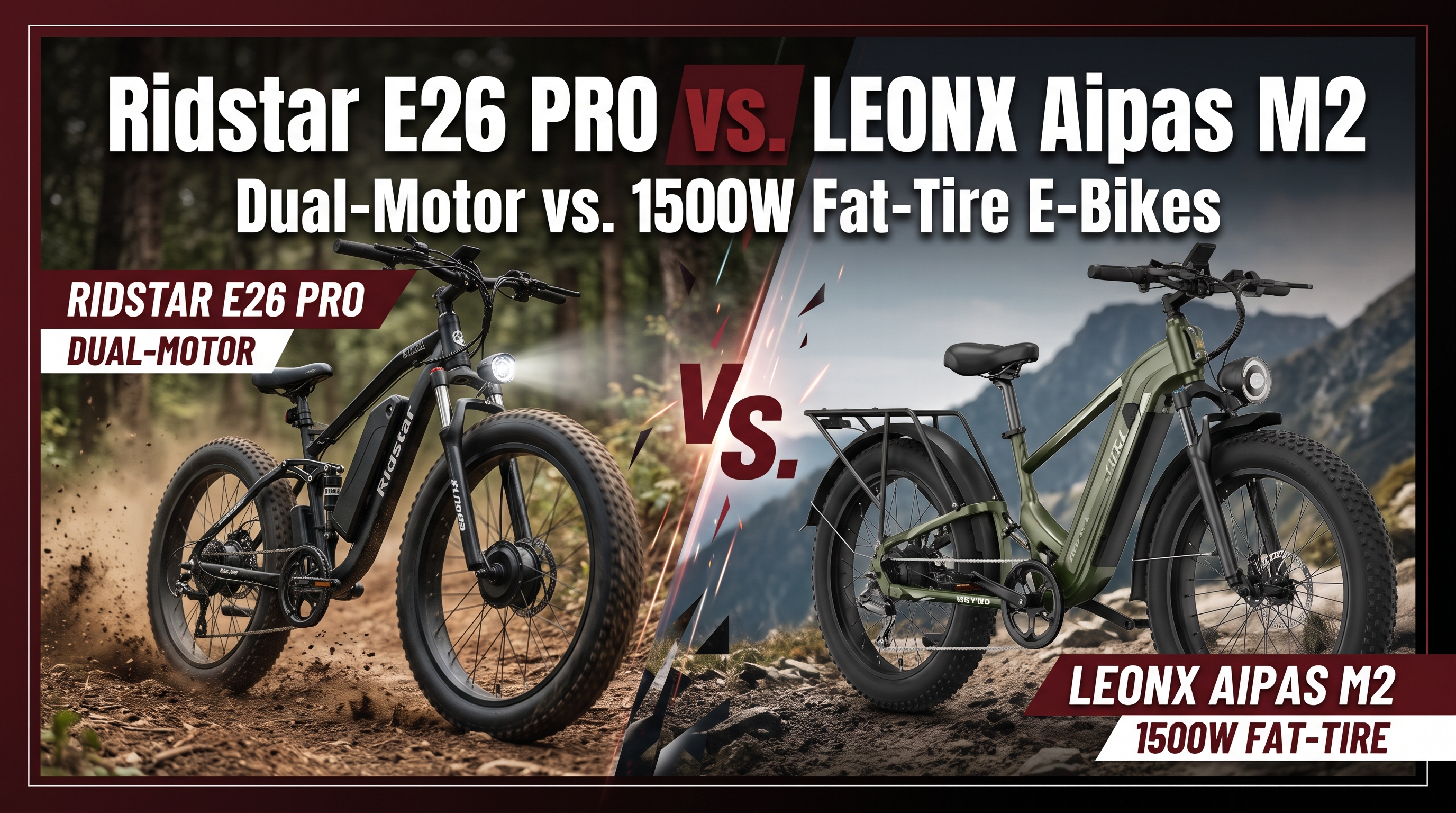
Ridstar E26 PRO vs. LEONX Aipas M2: Dual-Motor vs. 1500W Fat-Tire E-Bikes
Choosing a powerful fat-tire electric bike involves more than comparing advertised wattage. Motor configuration, battery capacity, tire design, braking performance, rider fit, and the terrain you plan to cover all influence the experience.
Two options worth comparing are the Ridstar E26 PRO dual-motor electric bike and the LEONX Aipas M2 1500W electric mountain bike.
Both listings target riders interested in fat tires, electric assistance, and outdoor versatility. The main question is whether the Ridstar's advertised dual-motor configuration suits your priorities better than the LEONX's advertised 1500W configuration.
In this guide, we'll compare their advertised specifications, explain the practical differences between dual- and single-motor designs, examine battery range, and identify the checks worth making before you buy.
Quick answer: Consider the Ridstar E26 PRO if its dual-motor configuration, larger advertised battery, and intended riding characteristics match your needs. Consider the LEONX Aipas M2 if its verified specifications, price, fit, and available features better suit your riding plans. Confirm the exact model specifications and local riding requirements before deciding.
Ridstar E26 PRO vs. LEONX Aipas M2: At a Glance
| Feature | Ridstar E26 PRO | LEONX Aipas M2 |
|---|---|---|
| Advertised motor configuration | Dual motors, 1000W each | Advertised as 1500W; verify the exact variant |
| Combined or advertised power | 2000W combined according to the listing | 1500W according to the LBRAWEE listing |
| Battery | 48V 23Ah advertised | Confirm the exact battery specification on the product page |
| Tire size | 26 × 4.0 inches advertised | 26-inch fat tires advertised; confirm width |
| Advertised top speed | Varies by listing and configuration | Up to 30 MPH in the store listing |
| Advertised range | Listing indicates 50–75 km maximum mileage | Verify the current listing for a comparable range figure |
| Best comparison criteria | Dual-motor configuration, battery capacity, terrain suitability | Verified motor specification, fit, price, and riding features |
| Store link | View Ridstar E26 PRO | View LEONX Aipas M2 |
Important: Advertised peak power, rated continuous power, speed, and maximum range are not necessarily directly comparable. Confirm the specifications for the exact products being sold, and do not treat manufacturer range or speed claims as guaranteed real-world results.
1. Dual-Motor vs. Single-Motor Electric Bikes: What's the Difference?
Motor configuration is one of the most important distinctions to understand when comparing powerful electric bikes.
How a dual-motor electric bike works
A dual-motor electric bike uses two motors, commonly one at the front wheel and another at the rear. When configured for all-wheel drive, both motors can contribute propulsion.
Potential benefits include:
- Traction flexibility: Power delivered to both wheels can help maintain forward motion on some loose or uneven surfaces.
- Acceleration: Depending on the controller, battery, traction, and total system output, two motors may deliver stronger acceleration.
- Climbing assistance: Additional available drive can help on inclines when the system is designed and operated appropriately.
- Riding adaptability: Multiple motor modes can let riders choose how much assistance to use.
However, two motors do not automatically mean twice the speed, twice the range, or twice the climbing ability. Performance depends on controller limits, total electrical output, gearing, traction, rider weight, and battery condition.
The Ridstar E26 PRO listing advertises two 1000W motors, for a combined advertised output of 2000W. Check the product details to confirm how the motors operate and which riding modes are available.
Explore the Ridstar E26 PRO at LBRAWEE
How a single-motor electric bike works
A single-motor e-bike uses one motor, often mounted in the rear hub on a fat-tire model.
Potential advantages include:
- A simpler drive configuration.
- Fewer motor components to maintain.
- Potentially lower electrical demand than a comparable dual-motor setup, depending on how each bike is ridden.
- A more straightforward option for riders who do not need two-wheel motor assistance.
A single-motor design can still provide useful climbing performance and off-road capability. Motor torque, gearing, tire traction, and the controller's power delivery matter alongside wattage.
The LEONX Aipas M2 is advertised by LBRAWEE as a 1500W electric mountain bike. Confirm its exact motor configuration and rated versus peak power on the current product listing before comparing it directly with the Ridstar.
Explore the LEONX Aipas M2 at LBRAWEE
2. Is 2000W Better Than 1500W?
Not necessarily. More advertised power can indicate greater potential output, but wattage alone does not establish which bike is better for a particular rider.
A useful comparison considers the following:
Power delivery: How smoothly does the motor respond when starting, climbing, or accelerating?
Torque: How much rotational force is available at the wheel? Torque, gearing, and controller behavior all influence hill-climbing performance.
Battery capability: Can the battery and electrical system supply the current demanded by the motor configuration?
Traction: Can the tires maintain grip on the intended surface?
Braking: Can the braking system manage the bike's weight and intended operating speeds safely?
Weight and handling: Can the rider control, maneuver, transport, and store the bike comfortably?
A bike with a lower advertised power figure may be the better choice for a particular route if it offers a more suitable riding position, reliable braking, better fit, or a more practical battery setup.
Likewise, a dual-motor model may appeal to riders who prioritize additional drive capability for suitable off-road use.
What to check before comparing wattage
- Confirm whether the stated wattage is nominal, rated continuous, or peak.
- Check whether the battery voltage and controller current support the advertised output.
- Verify whether the motors operate together or offer selectable modes.
- Compare the manufacturer's documented torque figures, if available.
- Check the bike's total weight and maximum permitted load.
- Verify that the configuration is legal for your intended roads and trails.
Avoid choosing solely on the largest number printed in a product title.
3. Battery Capacity and Real-World Range
Battery capacity is another major consideration when shopping for a fat-tire electric bike.
The Ridstar E26 PRO is listed with a 48V 23Ah battery. Its nominal energy capacity can be estimated using this formula:
Battery energy (Wh) = Voltage (V) × Capacity (Ah)
For the advertised Ridstar battery:
48V × 23Ah = 1,104Wh (nominal energy)
This is a calculated nominal value, not a guarantee of usable energy or travel distance. Battery management, operating conditions, and system losses affect the energy available to the rider.
For the LEONX Aipas M2, check the exact battery voltage and amp-hour rating on the current LBRAWEE product page before making a direct capacity comparison.
What affects e-bike range?
Several factors can substantially change how far an electric bike travels on a charge:
- Rider and cargo weight.
- Total elevation gain and steepness of climbs.
- Speed and acceleration.
- Throttle use versus pedal assistance.
- Tire pressure and rolling resistance.
- Ambient temperature.
- Battery age and condition.
- Stops, starts, and riding surface.
Bosch eBike Systems explains that temperature, rider and luggage weight, gearing, tire pressure, and riding patterns can influence range. These are general e-bike principles rather than a specific range test of either bike.
External reference: Bosch eBike Systems — Battery range factors
How to estimate your own range
Start with the manufacturer's stated range, then consider how your use differs from the conditions behind that estimate.
If you expect frequent steep climbs, high speeds, heavy loads, or extensive throttle use, plan conservatively and allow a reserve for the return journey.
Buyer tip: Before purchasing, verify the battery's exact specification, replacement availability, charger compatibility, warranty coverage, and expected charging time. These details can matter more over the ownership period than a headline range figure.
4. Why 26 × 4.0-Inch Fat Tires Matter
Fat tires are designed to provide a wider contact patch and can be useful on selected surfaces when matched with suitable tire pressure and tread.
Both bikes are marketed toward riders interested in fat-tire riding. The Ridstar E26 PRO listing specifies 26 × 4.0-inch tires. Confirm the LEONX's exact tire dimensions on its product page.
Benefits of fat tires
Loose gravel: A suitable tire can help the bike maintain contact with uneven surfaces, although loose material can still cause slipping.
Packed dirt: Fat tires can offer a stable, comfortable ride when pressure and tread are appropriate.
Sand: Wider tires can help spread the load over a larger area, but deep or soft sand remains challenging.
Snow: Tire width alone does not guarantee traction. Tire tread, pressure, temperature, surface conditions, and riding technique all matter.
Pavement: Fat tires can feel comfortable, but rolling resistance and handling vary with tire construction and pressure.
Tire pressure: Avoid one-size-fits-all advice
There is no single tire pressure that is best for every fat-tire bike or surface.
Follow the pressure range specified by the tire and bicycle manufacturer. Adjust only within the permitted range, considering rider weight, terrain, and tire construction.
Very low pressure can increase the risk of tire damage or rim impacts. Excessively high pressure can reduce comfort and grip on some surfaces.
Never assume a fat-tire bike is suitable for every off-road trail simply because the tires look large.
5. Suspension, Brakes, and Rider Comfort
Motor power is only one part of the riding experience. Suspension, braking, and ergonomics also influence confidence and control.
Suspension
When evaluating either model, inspect the manufacturer's specification for:
- Front suspension type and adjustment.
- Rear suspension, if fitted.
- Available travel.
- Suspension maintenance requirements.
- Rider and total-load limits.
Suspension can improve comfort over bumps, but it does not eliminate the need to choose a suitable speed for the terrain.
Braking performance
A heavy, powerful electric bike requires a braking system appropriate for its weight, speed, and intended use.
Before buying, confirm:
- Whether the bike uses mechanical or hydraulic disc brakes.
- Front and rear brake specifications.
- Replacement pad and rotor availability.
- Manufacturer guidance for brake bedding-in and maintenance.
- Whether the brakes are appropriate for the permitted operating speed and total load.
Do not assume that all disc brakes provide the same stopping performance.
Fit and handling
A comfortable fit makes it easier to maintain control, particularly on uneven terrain.
Review the recommended rider height, frame geometry, saddle adjustment, handlebar position, total bike weight, and maximum load. If possible, arrange a suitable test ride before committing to a purchase.
6. Which Bike Is Better for Hills, Gravel, and Outdoor Riding?
The right choice depends on the terrain, the rider, and the bike's verified specifications.
For steep climbs
A dual-motor setup can provide additional drive capability when both motors are designed to contribute power. However, traction, torque, controller settings, gearing, battery condition, and rider technique all influence climbing ability.
Do not assume the Ridstar will climb every hill better simply because its listing advertises more combined wattage.
For gravel and uneven paths
Both fat-tire designs may suit some gravel and recreational routes, subject to their actual tire, suspension, braking, and frame specifications.
Choose routes appropriate to the bike's construction and your skill level. Loose gravel, deep sand, wet surfaces, and steep descents require particular care.
For everyday commuting
Consider more than motor output:
- Is the bike legal on your intended roads and cycle paths?
- Is its weight practical for storage and transport?
- Is the battery sufficient for your round trip with reserve?
- Are the lights, brakes, and other components appropriate for regular use?
- Can you obtain replacement parts and servicing?
A powerful off-road-oriented e-bike is not automatically the best commuting option.
For longer recreational rides
Compare battery energy, realistic route distance, elevation, charging time, and rider comfort.
The best bike is one that can complete your usual ride with an appropriate energy reserve while remaining comfortable and controllable.
7. E-Bike Safety and Legal Requirements
Before purchasing either bike, verify its legal classification for the location where you intend to ride.
In the European Union, the ordinary pedal-assist cycle exclusion from the motor-vehicle type-approval framework is generally associated with a maximum continuous rated motor power of 250W, assistance that cuts off when pedalling stops, and assistance that progressively reduces and cuts off before 25 km/h.
Higher-powered configurations or bikes with different throttle and speed behavior may fall under different regulatory requirements. The classification depends on the actual vehicle and its configuration, not just its marketing name.
Read the relevant official framework here:
European Union — Regulation (EU) No 168/2013
Before riding, check local requirements for registration, insurance, helmets, permitted roads, cycle paths, and off-road access.
Practical safety checklist
- Wear a properly fitted helmet suitable for the type of riding.
- Inspect the brakes, tires, wheels, lights, and steering before each ride.
- Learn the bike's acceleration and braking behavior at a controlled speed.
- Reduce speed on wet, loose, or uneven surfaces.
- Avoid riding beyond your skill level or the manufacturer's permitted use.
- Use only the specified charger and follow the battery manufacturer's instructions.
- Do not ride a battery or electrical system that shows signs of damage.
- Confirm the bike's maximum load and operating limitations.
Buyer tip: Ask the retailer for the exact technical documentation and legal classification of the configuration being sold. Do not rely solely on a product title that advertises 1500W, 2000W, or a particular top speed.
8. Ridstar E26 PRO vs. LEONX Aipas M2: Which Should You Buy?
There is no universal winner. Your decision should reflect the verified specifications, price, intended route, and practical ownership requirements.
Choose the Ridstar E26 PRO if:
- You specifically want to evaluate a dual-motor configuration.
- Its advertised 48V 23Ah battery suits your expected riding requirements.
- The bike's weight, fit, braking system, and support arrangements work for you.
- You have verified its motor operation and legal suitability for your intended use.
View the Ridstar E26 PRO electric bike.
Choose the LEONX Aipas M2 if:
- Its verified motor and battery specifications suit your intended routes.
- Its fit, handling, braking, and suspension meet your needs.
- Its current price and available support offer the better overall value for you.
- You have confirmed that the exact configuration is appropriate for your intended riding location.
View the LEONX Aipas M2 electric mountain bike.
Compare both before deciding
Do not make the final decision on advertised wattage alone. Check the current listings, confirm the specifications that matter to you, and compare total cost, warranty, replacement parts, and riding suitability.
Browse All Electric Bicycles at LBRAWEE
Frequently Asked Questions
Is the Ridstar E26 PRO better than the LEONX Aipas M2?
It depends on your requirements. The Ridstar listing advertises dual 1000W motors and a 48V 23Ah battery. LBRAWEE advertises the LEONX Aipas M2 as a 1500W model. Verify the exact motor, battery, braking, and legal specifications before deciding.
Does a dual-motor electric bike have more range?
Not automatically. Two motors can increase electrical demand when both are used, while battery capacity, speed, rider weight, terrain, and assistance settings influence the actual distance travelled. Compare battery energy and realistic riding conditions rather than motor count alone.
Can a fat-tire electric bike ride on sand or snow?
Some fat-tire bikes can handle suitable sand or snow conditions, but capability depends on tire design, pressure, traction, rider skill, and surface conditions. Deep sand, ice, and steep or slippery terrain can remain hazardous.
Does a 1500W or 2000W e-bike qualify as a regular electric bicycle in the EU?
Not automatically. The ordinary EU pedal-assist bicycle exclusion generally uses a 250W maximum continuous rated motor-power limit and assistance cut-off conditions. Higher-powered models may require a different legal classification. Confirm the exact vehicle's documentation and local rules.
How far can the Ridstar E26 PRO travel on one charge?
LBRAWEE's listing advertises a maximum mileage figure of 50–75 km. Treat that as a claimed range rather than a guarantee. Actual distance depends on battery condition, rider weight, terrain, temperature, speed, and the level of motor assistance.
What should I check before buying a powerful fat-tire e-bike?
Check motor configuration, rated power, battery voltage and capacity, brakes, tire dimensions, rider fit, total weight, load limit, warranty, replacement-part availability, and legal suitability for your intended roads or trails.
Final Verdict
The Ridstar E26 PRO and LEONX Aipas M2 appeal to shoppers comparing powerful fat-tire electric bikes, but the best choice depends on more than advertised wattage.
The Ridstar's listed dual-motor configuration and 48V 23Ah battery make it worth considering for buyers who prioritize those features. The LEONX Aipas M2 deserves consideration when its verified specifications, fit, price, and riding characteristics align more closely with your needs.
Review the product details carefully, verify legal requirements, and choose the bike that fits your actual routes and ownership expectations.
Ready to compare your options?
---