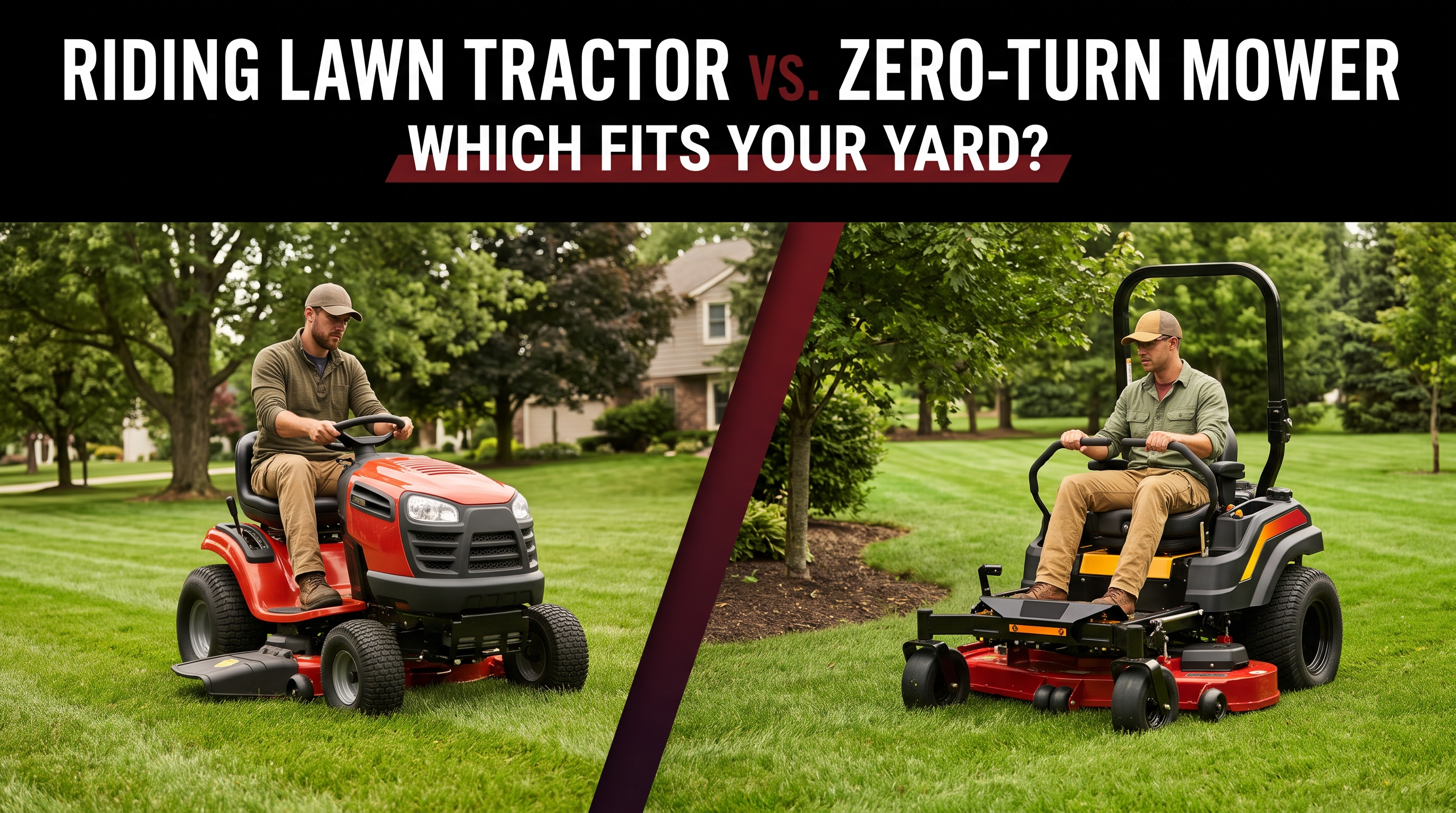
Riding Mower vs Zero Turn: Start With Your Yard
A bigger deck or a higher horsepower number does not automatically make a mower the right choice. The best starting point is your property: where you mow, what you mow around, how you get there, and where the machine will live afterward.
In the riding mower vs zero turn comparison, a lawn tractor deserves consideration if you prefer familiar steering-wheel controls or want to investigate approved yard-work attachments. A zero-turn deserves a look if repeated turns and obstacles dominate your mowing route. Neither category is automatically the right answer for slopes.
This guide explains the practical differences and highlights six options from LBRAWEE’s riding mowers category. Treat them as a research shortlist, not a performance ranking.
What Is the Difference?
“Riding mower” is an umbrella term: zero-turn mowers are riding mowers, too. Most shoppers using this comparison mean a conventional steering-wheel riding mower or lawn tractor versus a zero-turn mower.
A lawn tractor typically steers through its front wheels. A conventional lap-bar zero-turn changes direction by varying the drive speed on either side, allowing much tighter turns. Control layouts vary, so do not assume every zero-turn uses lap bars. Buyer tip: Confirm steering systems and control layouts for each shortlisted model.
Also, a compact riding mower and a lawn tractor are not necessarily interchangeable for utility work. Appearance, deck size, or the presence of a hitch does not establish attachment compatibility or towing capacity. Buyer tip: Confirm approved uses, attachments, and towing limits in each model’s documentation.
The useful question is not “Which category is better?” It is “Which machine matches my mowing route and the jobs its manufacturer permits?”
Five Yard Details That Should Drive Your Decision
1. Mowable Area, Not Total Lot Size
A property’s listed acreage includes the house, driveway, beds, patios, and other areas you will not mow. Estimate the actual lawn area before deciding how much mower to buy.
Then sketch its shape. A broad rectangle presents a different job from several small grass sections connected by narrow paths. Avoid rigid acreage rules: access, terrain, turning space, and your available mowing time all matter.
2. Gates and Other Bottlenecks
Measure the narrowest gate opening, the path beside the house, and the storage entrance. Leave room for comfortable maneuvering rather than planning around a barely possible fit.
A deck’s advertised cutting width is not the machine’s overall width. Discharge components and installed accessories can change the required clearance. Buyer tip: Obtain overall operating and storage dimensions, including discharge components and intended accessories.
A mower that suits the backyard but cannot reach it is not a useful upgrade.
3. Trees, Beds, and Repeated Turns
Count the obstacles that regularly interrupt a mowing pass. Trees, garden islands, fence corners, and play areas can make turning and repositioning a substantial part of the job.
A zero-turn’s tight-turning design may help on an obstacle-heavy layout, but that is not a promise of a specific time saving. Buyer tip: Confirm the shortlisted mower’s turning capability and operating guidance. Operator familiarity, spacing between obstacles, and ground conditions still influence the route.
On an open lawn with long passes, maneuverability may carry less weight than comfort, access, and service support.
4. Slopes and Ground Conditions
Treat terrain as a safety screen before comparing convenience features. Do not assume that a tractor is safe on a hill simply because it has a steering wheel, or that a zero-turn is suitable because it feels stable on level ground.
Identify slopes, ditch edges, retaining walls, pond banks, and soft areas. Check the exact operator’s manual for slope limits, travel direction, traction warnings, and required setbacks. Buyer tip: Confirm model-specific slope restrictions and instructions for operation near drop-offs and water.
If an area falls outside the manufacturer’s instructions, exclude it from the mower’s planned work. Do not stretch a safety limit to justify a purchase.
5. Storage and Service Access
Measure the parking space and consider how you will reach routine service points. Can you enter and exit the seat comfortably? Is there room to follow the manufacturer’s maintenance procedures?
For battery equipment, plan a charging location that meets the charger’s electrical and environmental requirements. Buyer tip: Confirm outlet, charging, temperature, ventilation, and storage requirements for the selected battery system.
Controls and Comfort Matter More Than They Look
Familiar controls can make a machine more approachable, but familiarity is not a substitute for reading the manual and learning its stopping procedures.
If possible, compare seating position and control reach before buying. Check whether you can operate the brake, parking controls, cutting-height adjustment, and blade engagement without awkward stretching. Ask how the mower changes speed and direction; do not infer the entire operating experience from “automatic” or “hydrostatic” in a listing.
For an unfamiliar control system, plan an initial practice session on a clear, level area, following the manufacturer’s instructions. Buyer tip: Confirm startup, stopping, training, and safe-operation procedures for the exact model.
Comfort is personal. Seat appearance alone will not tell you whether a mower fits your reach, mobility, or typical mowing session.
Gas or Battery Is a Separate Decision
Do not make this a tractor-versus-zero-turn shortcut. The supplied catalog includes electric choices in both categories.
For a gas model, review the specified fuel, engine service schedule, and seasonal storage procedures. Buyer tip: Confirm fuel requirements and maintenance intervals in the engine and mower manuals.
For a battery model, establish exactly which batteries and charger are included. Ask about charging time, storage requirements, battery warranty terms, and replacement options. Do not estimate usable mowing time from voltage alone. Buyer tip: Confirm package contents, battery capacity, runtime conditions, charging specifications, and warranty coverage.
Neither power source removes the need for mower maintenance. Compare the actual schedules rather than treating electric equipment as maintenance-free. Buyer tip: Review blade, deck, tire, drive-system, and other maintenance requirements for each model.
Six Mowers to Put on Your Research Shortlist
The names below reflect the supplied catalog. Detailed specification sheets were not provided, so verify the configuration before relying on a title’s measurements or powertrain details.
Craftsman 30-Inch Riding Lawn Mower
The Craftsman 30in 10.5 HP 344cc 6-Speed Riding Lawn Mower is a starting point when access and storage measurements make larger listed deck sizes less appealing. Buyer tip: Confirm cutting width, engine specifications, transmission, and overall dimensions.
Investigate this option if compact access is your first concern. Do not assume the listed 30-inch cutting width guarantees passage through a similarly sized gate.
Craftsman T2400 Riding Lawn Tractor
The Craftsman T2400 46-inch Hydrostatic Gas Riding Lawn Tractor belongs on a conventional tractor shortlist. Buyer tip: Confirm deck width, gas powertrain, hydrostatic transmission, and control layout.
Compare its documented dimensions with your mowing route, then evaluate seating and speed controls. If utility work matters, request its approved attachment list rather than assuming tractor styling establishes compatibility.
Troy-Bilt Bronco 42E XP Electric Tractor
The Troy-Bilt Bronco 42E XP Electric Riding Lawn Tractor provides a catalog-listed electric tractor option for shoppers who do not want to make zero-turn steering part of their battery-equipment search. Buyer tip: Confirm electric powertrain, steering layout, cutting width, and exact battery configuration.
Your next questions should concern included charging equipment, documented runtime conditions, storage instructions, and service support.
Cub Cadet Ultima ZT1-50 Zero-Turn
The Cub Cadet Ultima ZT1-50 Zero Turn Mower is listed with a 50-inch fabricated deck and a 25 HP Kohler V-twin engine. Buyer tip: Confirm deck construction, cutting width, engine model, and rated horsepower.
Consider it for comparison when your layout prompts a closer look at zero-turn maneuverability. Check overall width, controls, and terrain restrictions before deciding that the listed deck size suits your property.
Husqvarna Z248F Zero-Turn
The Husqvarna Z248F Zero Turn Mower is listed with a 48-inch deck and a 23 HP Kawasaki V-twin engine. Buyer tip: Confirm exact configuration, cutting width, engine, and rated horsepower.
Use it as another zero-turn comparison point, not as an assumed winner based on engine branding. Look closely at service access, operating instructions, dimensions, and comfort.
EGO Power+ Z6 Battery Zero-Turn
The EGO Power+ Z6 42-inch Battery Zero-Turn Riding Mower combines a catalog-listed battery powertrain with a zero-turn format. Buyer tip: Confirm cutting width, battery platform, control layout, and exact package contents.
Before comparing total cost, establish the included batteries and charger and whether the documented operating conditions resemble your lawn. Do not assume every package under a model-family name contains the same equipment.
Compare the Ownership Plan, Not Just the Mower
Build a purchase worksheet covering the machine, required accessories, maintenance supplies, storage preparations, and service arrangements. Add delivery or transport costs only after obtaining the applicable details.
If bagging, mulching, or towing matters, confirm compatibility before buying. A category label does not establish whether a particular kit is included or approved. Buyer tip: Confirm accessory part compatibility, included equipment, and attachment restrictions.
Also ask who can perform warranty work, how service transport is handled, and where replacement parts can be obtained. These practical questions deserve as much attention as deck width.
Which Should You Choose?
Start with a lawn tractor if steering-wheel operation is a priority and its documented capabilities fit your mowing and approved utility tasks.
Start with a zero-turn if your lawn’s turns and obstacles make maneuverability a priority, provided the model passes your access and terrain checks.
Before ordering either, confirm five things: safe terrain suitability, gate clearance, storage fit, comfortable controls, and a workable maintenance plan. Then browse LBRAWEE’s riding mowers with those requirements in hand. The right purchase is the mower that fits your whole property—not just its largest patch of grass.