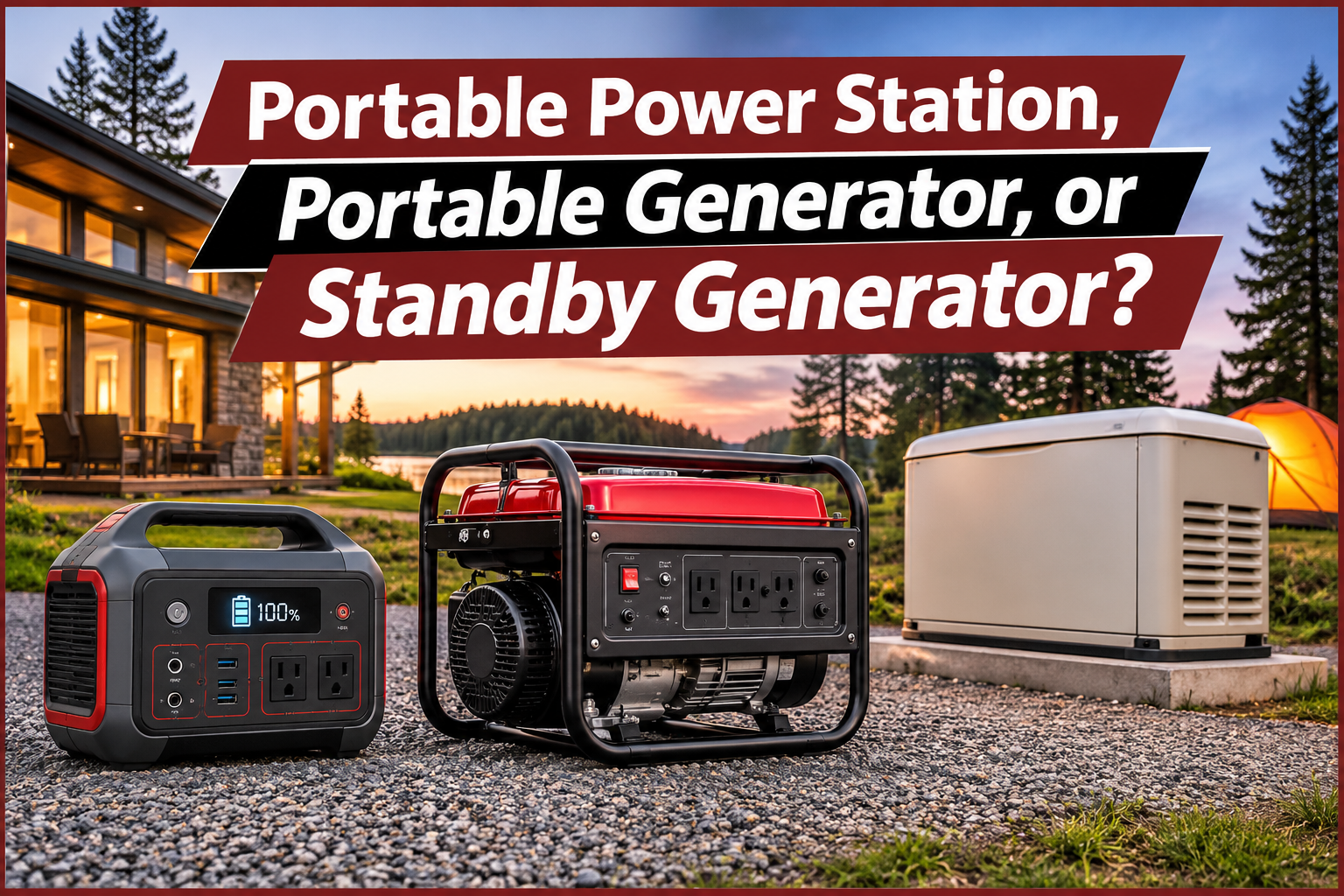
Portable Power Station, Portable Generator, or Standby Generator?
Choosing among home backup power options starts with four decisions: what needs electricity, how long it needs to run, how you will replenish energy, and how you will connect everything safely. Headline wattage answers only part of the question.
A battery power station stores energy for later use. A fuel-powered generator produces electricity by consuming fuel. An installed standby generator adds a permanent connection and installation plan rather than serving as a portable appliance power source.
You may also see battery equipment described as a “solar generator.” That label alone does not establish that solar panels are included, or that a particular panel is compatible.
The EcoFlow DELTA Pro, DuroMax XP5500EH, and Champion standby listing below represent three approaches—not interchangeable solutions. Their catalog specifications are preliminary, so treat listing titles as identifiers rather than verified performance promises.
Compare the three backup power options
Use this category-level comparison to narrow your approach. It does not establish the features of any particular model.
| Planning factor | Battery power station | Portable fuel generator | Installed standby generator |
|---|---|---|---|
| Energy source | Stored electrical energy | Fuel consumed by an engine | Fuel supplied to a permanently installed engine |
| Replenishment | Access to compatible charging equipment and an available energy source | Obtain and safely handle the approved fuel | Maintain the required fuel service or storage supply |
| Appliance or circuit connection | Suitable appliances directly; home circuits require an approved integration plan | Suitable appliances directly; home circuits require proper transfer equipment | Supplies designated home circuits through professionally installed transfer equipment |
| Setup effort | Plan storage, charging, placement, and connections | Plan outdoor operation, cords or home connection, and fuel storage | Arrange site assessment, electrical work, fuel work, and required approvals |
| Operating responsibilities | Monitor charge and manage loads | Monitor fuel, manage loads, and perform required maintenance | Arrange maintenance and keep the installation accessible |
| Project budget | Equipment, charging accessories, and any integration work | Equipment, cords, fuel supplies, and any electrical work | Equipment, transfer equipment, site preparation, electrical and fuel work, and permits |
If automatic operation matters, make it an explicit requirement. Do not assume a battery system or portable generator will take over unattended, or that a standby listing includes every component needed for automatic transfer.
Which appliances and circuits need backup?
Start with a household inventory, not a product comparison. Separate must-have loads from conveniences. Refrigeration, selected lights, communications equipment, or a sump pump may matter more to your household than cooking appliances or entertainment equipment.
For each load, record the following:
| Worksheet item | What to collect |
|---|---|
| Priority | Essential, useful, or able to remain off |
| Connection | Plug-in appliance or hardwired circuit |
| Running demand | Watts or nameplate electrical information |
| Starting demand | Startup requirement, if applicable |
| Electrical requirements | Voltage, amperage, plug type, and circuit requirements |
| Use pattern | Hours needed and whether operation is continuous or intermittent |
| Simultaneous use | Which other loads must operate at the same time |
Do not assume an appliance runs at full demand throughout the outage. Some loads cycle, while others draw power continuously. If nameplate information is unclear, consult the appliance documentation or an electrician rather than guessing. Backing up selected essentials is a different project from powering an entire home. A product title containing “home backup” does not establish whole-home coverage.
Account for running loads and starting loads
Watts measure power; watt-hours measure energy. Power determines whether equipment can support a load at a given moment. Stored energy helps determine how long a battery can supply that load.
Add the running demand of appliances that must operate together. Then account for startup requirements: motor-driven equipment can briefly need more power when starting. Simply adding running watts may overlook that demand.
Check voltage and circuit compatibility, too. A large wattage figure does not by itself establish that a source can operate a particular hardwired pump or other appliance.
For generators, determine whether the advertised figure is starting or continuous output and whether ratings differ by fuel. For batteries, check continuous output separately from surge capability.
How long must your backup last?
Choose an outage-duration goal before choosing equipment. Several hours of essential power requires a different plan from a multiday interruption.
For a battery system, a useful planning relationship is:
Estimated runtime in hours = usable energy available to the loads in watt-hours ÷ average load in watts.
For illustration only, 1,000 usable watt-hours delivered to a steady 100-watt load would represent about 10 hours. That is arithmetic, not a runtime claim for any featured product. If you begin with nominal battery capacity, account for conversion losses, system consumption, and operating conditions before estimating runtime.
Generator planning revolves around fuel consumption at your expected load and the fuel you can actually obtain. One published runtime figure cannot describe every household’s usage. always check usable battery capacity, manufacturer runtime conditions, fuel consumption, and applicable operating limits.]
Reducing simultaneous demand can help with power requirements. Reducing total appliance use also reduces the energy you must supply over time.
How will you replenish energy during an outage?
Ask whether your replenishment plan still works when the utility is unavailable.
- Battery charging: A wall outlet is useful before an outage, but it is not an outage replenishment source unless another supply powers it.
- Solar charging: Consider sunlight, shade, weather, panel placement, and compatible equipment. Do not assume consistent daily production or included panels.
- Portable-generator fuel: Consider approved storage, safe handling, and whether you can obtain more fuel during a regional disruption.
- Installed fuel service: Ask the installer what supply capacity and infrastructure the system requires, and what could interrupt that supply.
Charging time and fuel flexibility can influence a purchase, but compare documented requirements rather than slogans. and check model-specific charging methods and times, approved fuels, and replenishment restrictions.
How will you connect equipment safely?
There are two distinct plans: plugging suitable appliances directly into equipment, or supplying home circuits.
Direct appliance use still requires compatible outlets, properly rated cords where permitted, and protection against damage and overloaded connections. Follow the source equipment and appliance instructions.
Never backfeed through a household outlet or use a male-to-male cord. These practices can create deadly electrical hazards.
For home-circuit connections, have a qualified electrician review transfer equipment, circuit selection, grounding and bonding, permits, and local requirements. The installation must safely isolate backup power from the utility supply. Do not improvise a panel connection.
A battery unit’s receptacles or a generator’s output rating do not establish home-integration compatibility.
Carbon monoxide and operating safety
Fuel-powered portable generators must run outdoors—never inside a home, garage, basement, or enclosed space, even with doors open. Keep them at least 20 feet from the home, with exhaust directed away from doors, windows, and vents. Maintain working carbon monoxide alarms in the home; alarms do not make unsafe placement acceptable.
Plan for weather without enclosing the generator or trapping exhaust. Follow manufacturer requirements for clearances and approved weather protection and model-specific placement, exhaust direction, clearances, and weather-protection instructions.
Shut a portable generator down and let it cool before refueling. Keep fuel in approved containers away from ignition sources, following applicable storage rules.
Permanently installed standby generators have their own siting and clearance requirements. Do not substitute portable-generator placement guidance for a professional standby installation plan.
Battery equipment does not produce engine exhaust during discharge, but still needs appropriate placement and protection.
Three catalog examples to investigate
EcoFlow DELTA Pro: investigate the battery approach
Use the EcoFlow DELTA Pro listing to explore stored-energy backup. This is the selected DELTA Pro listing, not the separately listed DELTA Pro 3.
Before choosing it, confirm:
- Exact model identity, usable energy, continuous output, and surge limits.
- Outlet voltage and compatibility with your essential appliances.
- Supported charging methods and what charging equipment is included.
- Whether your intended home-circuit connection requires additional approved equipment.
The decision question is whether your energy needs and replenishment plan fit a battery-based system—not just whether the output number looks sufficient.
DuroMax XP5500EH: investigate portable fuel power
Use the DuroMax XP5500EH listing to investigate portable engine-powered backup.
Your checklist should cover:
- Starting versus running output and any differences by fuel.
- Approved fuel options and practical storage arrangements.
- Outlet and voltage compatibility with your loads.
- Safe outdoor placement, maintenance, and approved home connections.
The key question is whether you can safely operate, replenish, and maintain portable equipment throughout your planned outage.
Champion standby generator: investigate permanent installation
Use the Champion standby generator listing as a starting point for an installer conversation.
Ask the installer to confirm:
- Which loads the system can support together.
- Exact transfer equipment included and its compatibility with your electrical service.
- Fuel-supply requirements and site suitability.
- Automatic-operation capabilities, permits, maintenance, and installation scope.
Do not treat the transfer-switch wording in the title as proof of a complete installation package or whole-home coverage.
Choose your next step
Before comparing individual models:
- Inventory essential loads and their electrical requirements.
- Choose an outage-duration goal.
- Confirm a workable charging or fuel-replenishment plan.
- Assess safe equipment placement.
- Obtain electrical or installation review for home-circuit connections.
- Compare total project costs: equipment, accessories, installation, permits, fuel or charging, and maintenance.
Then browse generators and power stations with that checklist in hand. The right approach is the one that fits your loads, outage plan, and property—not automatically the one with the largest wattage figure.