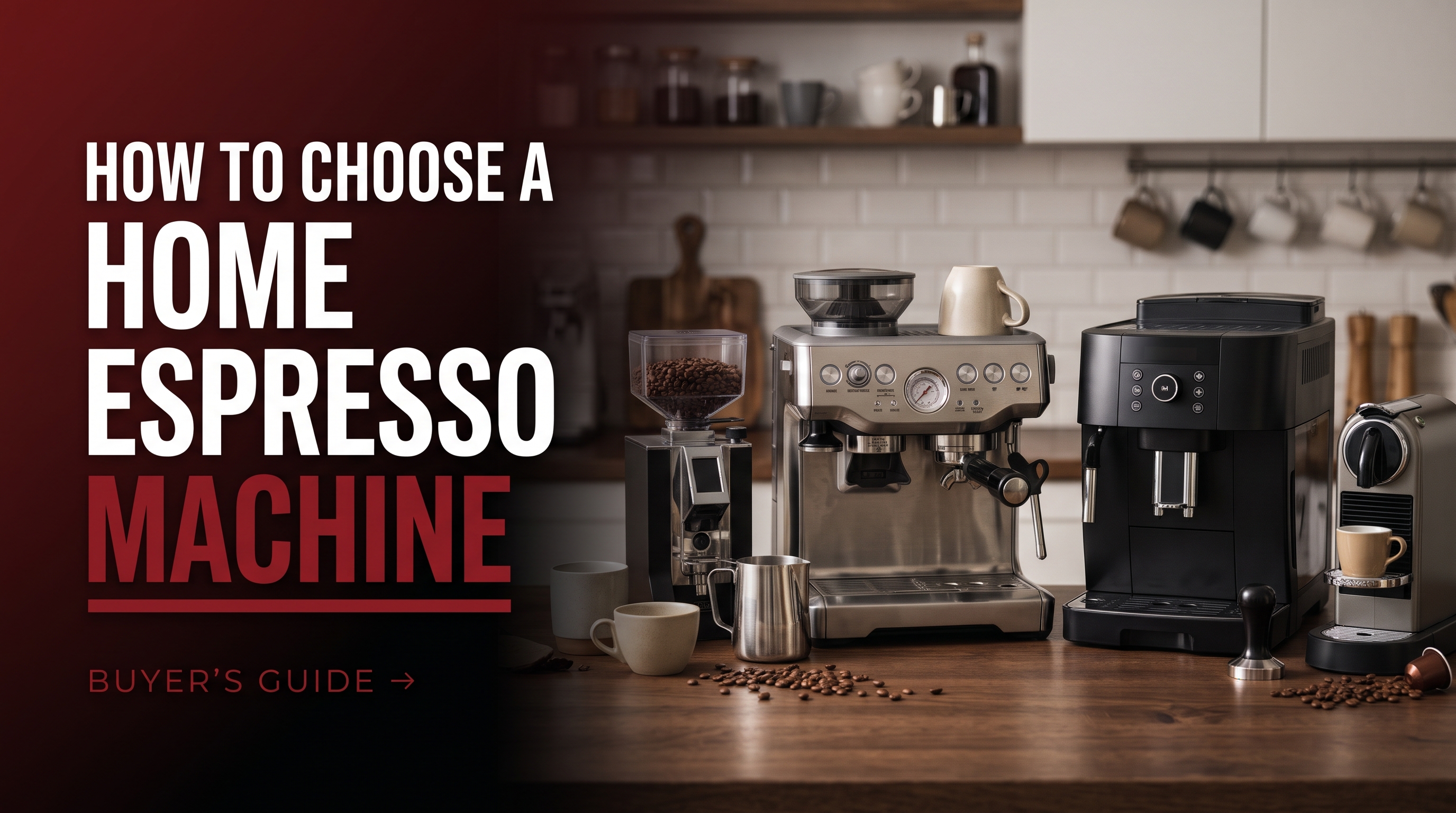
A home espresso machine should fit the way you actually drink coffee. Someone who enjoys adjusting a shot on Saturday morning may want a different setup from someone making two lattes before work. Neither approach is better; they simply call for different equipment.
Start with three questions: What drinks do you make most often? How much hands-on work do you want? And how much counter space and cleanup time can you spare?
This guide explains the main choices and offers a few catalog examples to investigate. Product-specific details marked ** need confirmation against manufacturer documentation before you rely on them for a purchase.
1. Choose a machine type that matches your involvement
Machine categories describe how much work you do, but the labels are not perfectly consistent across retailers. Compare the actual brewing steps rather than assuming that “automatic” means every task is handled for you.
Manual: for people who enjoy the process
Traditional manual espresso machines use a lever-operated brewing mechanism. Depending on the design, you may control more of the pressure and timing yourself. You also prepare the coffee and handle cleanup.
This approach is worth considering if learning the process is part of the appeal. It is less suited to someone who wants minimal decisions before breakfast.
Before buying, establish whether the machine heats its own water, how it generates brewing pressure, and whether it has any milk-steaming capability. “Manual” alone does not answer those questions.
Semi-automatic: hands-on preparation with powered brewing
A semi-automatic setup typically leaves grinding, dosing, distributing, and tamping to you while a pump handles brewing pressure. Shot stopping may be manual or programmed, depending on the model.
This category suits shoppers who want to influence their espresso without controlling every part of brewing mechanically. Expect some adjustment when changing coffee beans or recipes.
Do not mistake an integrated grinder or touchscreen for fully automatic preparation. Ask whether you still need to move a portafilter—the handled basket that holds the coffee—between grinding and brewing.
Super-automatic: fewer manual brewing steps
Super-automatic machines generally combine grinding and brewing inside the machine. Milk preparation varies: some systems automate it, while others require separate hands-on work.
These machines are worth investigating when convenience and repeatable routines matter more than controlling every preparation step. Still, automated brewing does not eliminate emptying grounds, refilling water, or cleaning milk-contact parts.
The catalog includes the La Cimbali S-Lite, listed as a super-automatic machine. Buyer tip: Confirm the exact model’s brewing workflow, milk configuration, electrical requirements, and suitability for residential installation. Treat it as a research candidate, not an assumed fit for a household kitchen.
Capsule machines: another route to convenience
Capsule machines use preportioned coffee instead of a separate grinding and dosing routine. They deserve a place on your shortlist if straightforward preparation matters more than choosing and adjusting whole beans.
Compare compatible capsules, cost per serving, disposal requirements, and how you will prepare milk. Do not assume that two capsule systems are interchangeable.
The Lavazza Blue LB 910 is listed in the catalog as a capsule espresso machine. Buyer tip: Confirm compatible capsule formats, milk capabilities, dimensions, and household electrical requirements.
2. Decide between a built-in and separate grinder
For a whole-bean setup, consider the grinder as part of the purchase rather than an accessory to sort out later. Grinding is one of the adjustments you will use when dialing in espresso.
Why choose a built-in grinder?
An integrated grinder puts grinding and brewing in one appliance. That may simplify your shopping and keep the coffee station organized, although it does not automatically mean the smallest overall footprint.
The Breville Barista Express catalog entry lists an integrated conical burr grinder with 16 settings. Buyer tip: Confirm grinder specifications for the exact model and version being sold. It is a candidate to investigate if you want a combined grinding-and-brewing setup.
Before choosing an integrated design, ask:
- Can you make the grind adjustments your coffee requires?
- How do you access the grinder for cleaning?
- Can you use preground coffee when needed?
- What happens to your daily routine if the appliance needs service?
Why choose a separate grinder?
A separate grinder lets you choose and replace the grinder independently of the machine. It can also make sense if you already own a suitable espresso grinder.
The trade-offs are another appliance, another cord, and more workspace to plan. Include the grinder in both your budget and your counter measurements.
Do not choose solely by the advertised number of grind settings. Investigate espresso suitability, adjustment control, cleaning access, and the workflow for measuring coffee. A larger settings count alone does not establish better results.
3. Walk through your daily drinks and milk routine
Imagine making your usual order from start to finish. Include filling the tank, preparing coffee, brewing, frothing milk, and cleaning afterward—not just pressing the brew button.
For someone who mainly drinks straight espresso, milk features may deserve little weight. For a household making several cappuccinos, they can shape the entire purchase.
Manual steaming versus automated milk preparation
A manual steam wand gives you responsibility for pitcher position and milk texture. It also creates a skill to learn. An automated milk system may reduce that hands-on work, but its cleaning process still needs scrutiny.
The Breville Barista Touch catalog entry lists automatic milk texturing with adjustable temperature and texture. Buyer tip: Confirm milk controls, supported workflow, and cleaning instructions for the exact model. Investigate it if milk assistance is a priority, while checking which coffee-preparation steps remain manual.
If you use dairy alternatives, look for manufacturer guidance on supported milk types. Do not assume every milk system performs the same way with every beverage.
Think beyond the first cup
Ask how the machine handles your busiest realistic morning. Can you move easily between brewing and steaming? What must be emptied or refilled while making several drinks? How long does the complete process take?
Compare ready-to-brew time with the time required to finish your actual drink. A heating-system claim is not necessarily a promise that coffee preparation, milk steaming, and cleanup all happen within that interval.
4. Measure the working space, not just the appliance
An espresso machine needs room to operate. Its listed width and depth do not describe every clearance your kitchen will need.
Before ordering, measure:
- Overhead space: Can you open the bean hopper or remove the tank beneath your cabinets?
- Front clearance: Is there room to insert the portafilter and remove the drip tray?
- Side access: Can you position a milk pitcher comfortably?
- Cup clearance: Will your preferred cups fit beneath the outlets?
- Accessory space: Where will the grinder, scale, tamper, and used grounds go?
Map the setup with paper or cardboard on your counter. Include the space you need while making coffee, not just while everything is stored.
Plan water and electrical access
Check how the water reservoir fills and whether you can reach it without moving the machine. A removable tank is useful only if you have clearance to remove it.
If a model requires a permanent water connection, establish plumbing and installation requirements before purchasing. For any machine, confirm voltage, plug type, power requirements, and installation clearances in the manufacturer’s documentation. Do not assume every item in a broad coffee-equipment category is intended for a standard home setup.
5. Understand cleaning before you buy
Cleaning is part of ownership, not an optional extra. Look at the maintenance instructions while comparing machines, especially if convenience is your main reason for upgrading.
Daily tasks to investigate
Typical responsibilities include disposing of used coffee, emptying the drip tray, and cleaning coffee- and milk-contact surfaces. The exact procedure depends on the design.
For milk systems, find out which parts must be cleaned after each use, which are removable, and whether cleaning requires a dedicated product. A convenient drink button can still come with a multistep cleanup routine.
For whole-bean machines, check access to the grinder and brewing components. Do not assume an internal brew unit is user-removable.
Periodic maintenance and water care
Ask about descaling, filters, cleaning tablets, seals, and service intervals. Follow the model’s instructions rather than applying a generic maintenance schedule.
Backflushing—cleaning through a machine’s brew circuit—is not appropriate for every design. Only perform it when the manufacturer specifies the procedure and suitable materials.
Water recommendations also vary. Check the manufacturer’s guidance for hardness, filtration, and descaling. Do not assume that bottled, distilled, or heavily filtered water automatically meets those requirements.
Finally, investigate warranty terms, service options, and replacement-part access. A machine that fits your budget should also have an ownership plan you are comfortable with.
6. Build a shortlist around purchase criteria
Rather than ranking machines by the longest feature list, separate your requirements into essentials and preferences.
Start with these essentials
- Drink fit: Does it make your usual drinks through a workflow you want to repeat?
- Effort level: Are you comfortable grinding, tamping, steaming, and adjusting, or do you want fewer manual steps?
- Physical fit: Can you operate, refill, and clean it in your available space?
- Installation fit: Are its electrical and water requirements appropriate for your home?
- Maintenance fit: Can you realistically keep up with the prescribed cleaning?
- Total budget: Have you allowed for any grinder, milk tools, cleaning supplies, filters, coffee, and future service?
Then compare preferences such as display style, finish, programmable drinks, and accessory storage. These can improve everyday use, but they should not outweigh a poor fit on the essentials.
Make your final comparison concrete
For each shortlisted machine, write down the steps required to make your usual drink and leave the station clean. Add any unanswered questions beside those steps. This turns vague promises of convenience into something you can evaluate.
Browse espresso machine options in Home Deals, then confirm the exact model’s specifications and instructions before ordering. The best home espresso machine for you is the one whose daily routine, space requirements, and upkeep fit your household—not simply the one with the most features.