Start With Your Garage, Not the Lift’s Capacity
A home garage car lift is a substantial equipment purchase, but choosing one starts with a simple question: What do you want to do with it? Routine wheel service, extensive underbody repairs and vehicle storage can lead to different shortlists.
Your garage matters just as much. Ceiling obstructions, concrete condition, vehicle dimensions and available electrical service all belong in the decision before you order.
This guide compares 2-post, 4-post and scissor layouts, then highlights five options from LBRAWEE’s car lifts category. Product names provide a starting point, not complete installation specifications. Treat every candidate as provisional until its current manufacturer documentation confirms that it suits your vehicle and garage.
Compare the Three Main Lift Styles
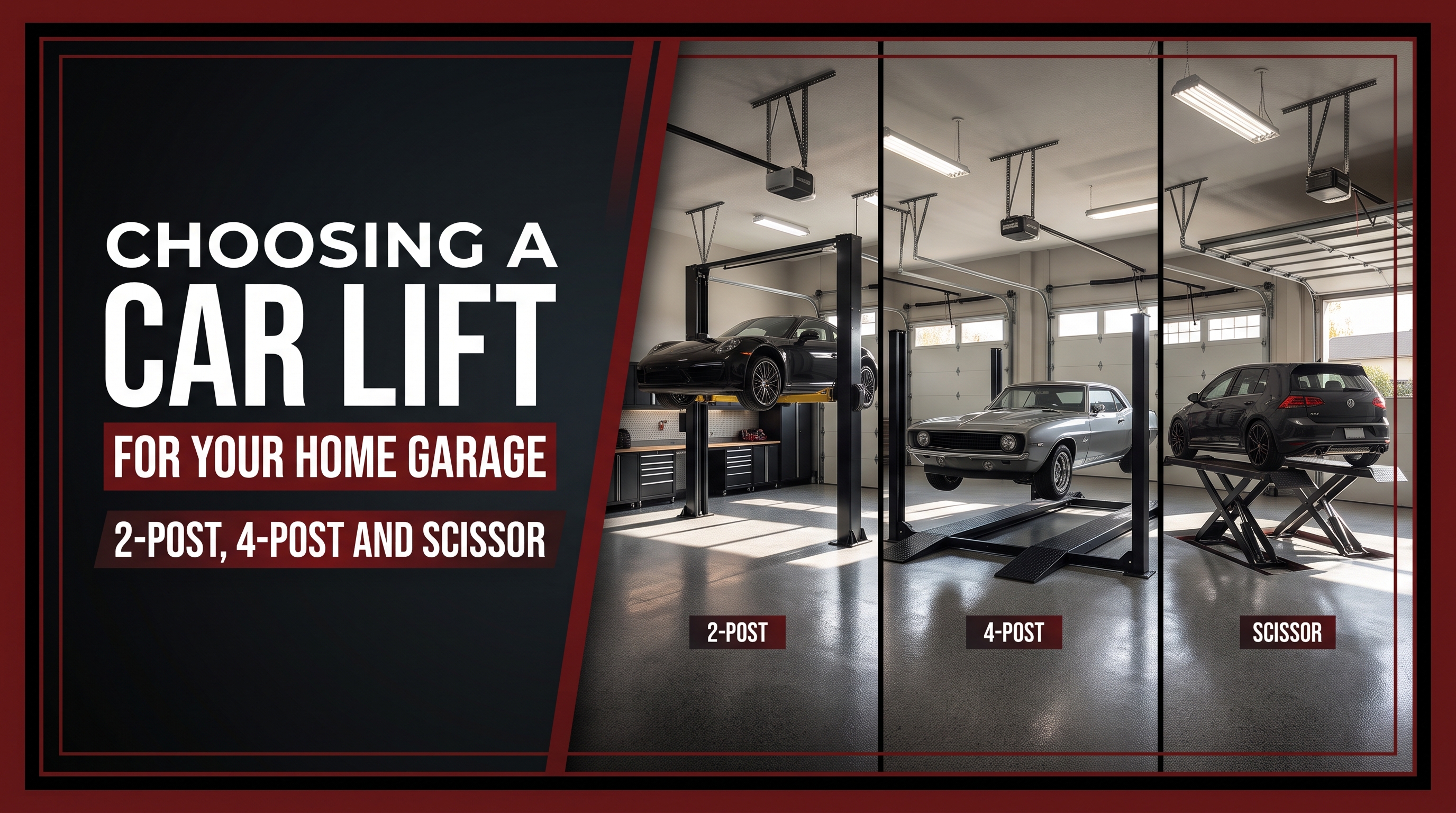
2-post lifts: Start here for repair-focused shopping
A conventional 2-post lift supports a vehicle at designated lifting points using arms positioned beneath it, rather than supporting the tires on runways. That arrangement can provide wheel-free access for repair work. Buyer tip: Confirm the selected lift’s support method, arm configuration and approved service applications.
Consider this style if your plans center on brakes, suspension or other repairs requiring access around the wheels and underside. However, capacity alone cannot establish compatibility. Arm reach, pad placement, vehicle balance and access to the vehicle’s approved lifting points all require review. Buyer tip: Check lift loading limits and vehicle lifting-point instructions.
Also compare the physical layouts. Do not assume that a baseplate model automatically fits a low ceiling or that an overhead model leaves enough clearance for your tallest vehicle. Request the complete installation drawing for either configuration.
4-post lifts: Compare for parking-oriented projects
A conventional 4-post lift supports a vehicle on runways beneath its tires. For wheel-off service, an approved auxiliary lifting arrangement may be necessary. Buyer tip: Confirm runway configuration, compatible auxiliary equipment and permitted service procedures.
This style belongs on your shortlist if you are investigating additional parking or prefer a drive-on arrangement. Do not assume every 4-post model is approved for long-term vehicle storage or parking another vehicle underneath. Buyer tip: Confirm manufacturer-approved storage use and required accessories or precautions.
Measure the whole installation area, including ramps, approach space and room around the posts. A lift that fits on paper can still make the garage awkward to enter, park in or walk through.
Scissor lifts: Compare working height and access carefully
Scissor lifts are available in different lifting-height and platform configurations. The structure beneath the vehicle can affect which service areas remain accessible. Buyer tip: Confirm the selected model’s lifting range, platform layout and underbody access.
This category is worth comparing if you want to focus on particular maintenance jobs rather than assume you need a full-height lift. Decide whether your intended work calls for standing, sitting or another working position, then compare the documented raised height against your vehicle and ceiling.
Treat descriptions such as “mid-rise,” “portable” and “open-center” as prompts for questions. None tells you, by itself, whether a specific exhaust, drivetrain or wheel-service job is practical.
Measure the Space You Actually Have
Check ceiling clearance throughout the movement path
Measure floor-to-ceiling height, but also record the lowest obstructions: door tracks, an open garage door, lighting, beams and the door opener. Sketch where each sits relative to the proposed lift.
For any candidate, ask the installer to evaluate the vehicle’s highest point throughout the intended lifting range, along with the lift’s own structural clearances. Buyer tip: Use the model’s clearance requirements and installation drawing.
If your goal is stacked parking, measure both vehicles. Do not estimate fit from ceiling height alone; the complete lift-and-vehicle arrangement must be checked. Buyer tip: Confirm usable under-runway clearance, runway thickness, lock positions and approved stacked-storage configuration.
Leave room for daily garage use
Mark the proposed footprint with tape. Include ramps or approach areas where applicable, then try walking through the space and opening the vehicle’s doors.
Ask yourself:
- Can I enter and leave without a difficult approach?
- Will the lift block cabinets, tools or a household doorway?
- Where will removed wheels and parts go?
- Can I still use the garage comfortably when the lift is idle?
These checks will not replace an installation plan, but they can expose an inconvenient layout before you commit.
Confirm Vehicle Compatibility Beyond Weight
Write down the vehicles you intend to lift, including their weight, dimensions, ground clearance and any modifications. Account for carried equipment or accessories rather than relying only on a remembered curb-weight figure.
Use the stated capacity as an initial screening tool, not a complete compatibility test. The manufacturer’s rules may also address load distribution, lifting-point spacing and vehicle positioning. Buyer tip: Confirm model-specific capacity restrictions and loading instructions.
For a 2-post candidate, request confirmation that the arms and approved adapters reach the vehicle’s specified lifting points. For a 4-post candidate, check tire placement, runway dimensions and approach clearance. For a scissor candidate, compare support locations, lowered height and access around the lifting structure. Buyer tip: Check the selected lift’s vehicle-fit dimensions against vehicle manufacturer lifting guidance.
Do not purchase on the assumption that a generic adapter will solve a mismatch. Get the required configuration confirmed first.
Resolve Concrete, Power and Installation Before Ordering
Have the slab evaluated
Do not assume an existing garage slab is suitable because it looks solid. Obtain the lift manufacturer’s foundation requirements, then have a qualified installer or structural professional assess the proposed location.
Concrete thickness, strength, condition, reinforcement, joints and anchor placement may affect whether an installation is acceptable. Buyer tip: Confirm the selected model’s foundation and anchoring requirements.
If the slab’s construction is unknown, resolve that uncertainty before installation. Do not drill into a slab that may contain post-tensioning, utilities or other embedded hazards without appropriate professional evaluation.
“Portable” is not permission to disregard foundation or anchoring instructions. Buyer tip: Confirm anchoring requirements and approved relocation procedures for any portable model.
Get an installed-cost estimate
Request a written estimate covering delivery and unloading, assembly, anchoring where required, electrical work and any necessary concrete work. Ask what accessories and commissioning services are included.
Have an electrician compare the documented power requirements with your garage’s available service. Do not infer voltage, amperage, plug type or circuit requirements from a product photograph or lift category. Buyer tip: Confirm the exact power-unit electrical specifications.
Compare candidates using their complete installed cost, not just the equipment price.
Five Catalog Options to Investigate
These selections represent different shopping priorities, not a ranking. Capacity and configuration descriptions below come from the supplied catalog names; complete technical specifications were not provided.
Atlas 9KBPX 9,000 LB Baseplate 2-Post Lift
The Atlas 9KBPX is a baseplate 2-post option to investigate for a repair-focused garage.
Before shortlisting it, request overall dimensions, arm reach, pad-height range and foundation requirements. Also evaluate how the baseplate layout affects movement through your workspace. Buyer tip: Confirm current 9KBPX dimensions, vehicle-fit limits and installation requirements.
MaxJax M7K Portable Two-Post Lift
The MaxJax M7K is a candidate for shoppers interested in a two-post model described as portable.
Ask exactly what relocation involves, where the components can be stored and what installation remains necessary for use. Do not infer its capacity from the model name. Buyer tip: Confirm rated capacity, anchoring system, relocation procedure and component handling requirements.
Atlas Garage Pro 8000 LB Four-Post Lift
The Atlas Garage Pro four-post lift offers a catalog-listed 8,000-pound option for comparing a runway-style layout.
For parking-oriented plans, request explicit storage-use guidance. For maintenance, ask which wheel-free lifting accessories, if any, are approved and included. Buyer tip: Confirm storage authorization, runway dimensions, usable clearances and accessory compatibility.
BendPak MD-6XP Mid-Rise Scissor Lift
The BendPak MD-6XP is listed as a 6,000-pound mid-rise scissor lift.
Compare it with your planned tasks rather than assuming mid-rise operation provides the access you need. Request lowered and raised dimensions, support-point details and an underside layout drawing. Buyer tip: Confirm lifting range, vehicle support requirements and service-access limitations.
BendPak MDS-6LP Mid-Rise Open-Center Lift
The BendPak MDS-6LP is cataloged as a 6,000-pound mid-rise open-center scissor lift.
If access beneath the center of the vehicle is important, compare the actual opening and structure with the components you intend to service. “Open-center” is not a guarantee of unrestricted access. Buyer tip: Confirm opening dimensions, support locations and approved applications.
Make the Final Decision With a Written Checklist
Before ordering, collect the current manual, installation drawing and a written installation estimate. Confirm:
- Your vehicles meet the lift’s weight and fit requirements.
- The garage provides the required operating clearances.
- The slab and electrical supply have been evaluated.
- Required adapters and accessories are identified.
- Delivery, unloading and assembly responsibilities are clear.
- You understand the manufacturer’s operating, locking, inspection and maintenance procedures. Buyer tip: Review all model-specific safety and maintenance instructions.
Choose by task first, then eliminate models that do not fit the vehicle or building. Compare 2-post lifts for repair access, 4-post lifts for runway-based projects and approved storage, and scissor lifts for the working height and access your jobs require.
Browse LBRAWEE’s car lifts to build your shortlist, then verify each candidate before committing. The right home garage car lift is the one whose documented requirements match your actual garage and intended work.