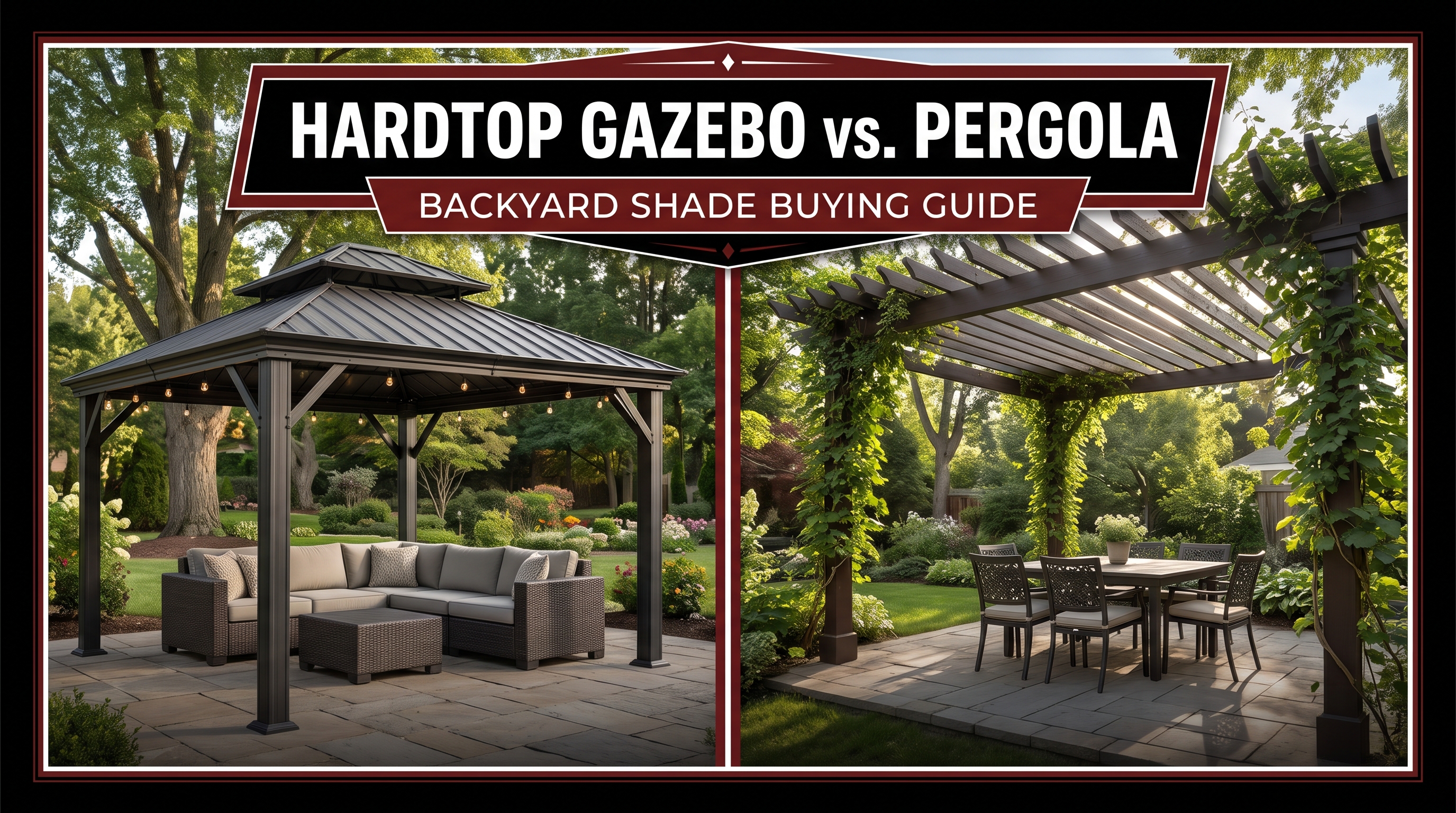
Hardtop Gazebo vs Pergola: Start With How You’ll Use It
Choosing between a hardtop gazebo and a pergola starts with a practical question: Do you want a covered outdoor destination, or an open framework that defines your backyard space?
A hardtop gazebo has a rigid overhead roof. A traditional pergola has an open overhead framework, although some models include fabric shade or other coverings. Those differences matter more than whether a structure looks traditional or modern.
For the hardtop gazebo vs pergola decision, start with your priorities: when you sit outside, how much sun you want, whether rain interrupts your plans, and how much installation work your site needs. Then compare individual models rather than assuming every gazebo or pergola performs alike.
Browse the gazebos and pergolas category alongside this guide to build a shortlist.
The Main Differences at a Glance
| Buying consideration | Hardtop gazebo | Pergola |
|---|---|---|
| Overhead design | Rigid roof | Typically an open framework; some models add shade coverings |
| Best starting point for | A roofed dining or lounging area | An open outdoor room or garden feature |
| Sun planning | Consider roof coverage and sunlight entering from the sides | Consider slat spacing, orientation, and any added covering |
| Rain planning | Check roof construction, drainage, and coverage | Do not assume an open frame or shade canopy provides rain protection |
| Visual effect | More enclosed overhead | More open to the sky |
| Installation questions | Foundation, anchors, roof assembly, and local requirements | Foundation, anchors, frame assembly, and any canopy requirements |
Neither category automatically wins on durability, maintenance, or value. Those depend on the exact materials, design, installation instructions, and conditions at your property.
Shade and Rain: Decide What Coverage Means to You
For shade, study the sun rather than just the footprint
A structure’s advertised dimensions do not tell you where its shadow will fall throughout the day. Low-angle morning or afternoon sunlight can reach seating from the sides, even beneath a solid roof.
Mark the proposed location and observe it during the hours you actually use the yard. If you mostly eat outside at 6 p.m., evaluate that time—not just noon. Note which direction the sun comes from and where you want chairs or a dining table.
An open pergola makes sense when you want some connection to the sky and are comfortable planning around changing sunlight. If stronger shade is your priority, investigate the exact overhead design. Any claimed shade percentage or UV protection needs model-specific documentation. Buyer tip: Manufacturer shade and UV performance for the selected covering.
For rain, inspect the roof details
A rigid roof is the more relevant starting point when overhead rain coverage is a major goal. However, a roofed structure is not a sealed outdoor room. Wind-driven rain can enter through open sides, and furniture near the perimeter may still get wet.
Before buying, check the roof material, panel joints, slope, runoff direction, and whether gutters are included. Buyer tip: Manufacturer roof construction and drainage details for the selected model.
Do not treat a sail shade or soft canopy as a waterproof roof unless the manufacturer explicitly documents that capability. Buyer tip: Canopy water-resistance or waterproof rating and permitted weather use.
Size the Structure Around Furniture and Movement
Start with the activities you want to accommodate. A dining area needs room to pull chairs out. A lounge needs walking space around seating. A mixed-use area needs both, without blocking doors or the route back to the house.
Use painter’s tape, string, or temporary markers to lay out the proposed structure. Add your furniture footprint, then walk through the space as if people were already seated.
Before ordering, distinguish between:
- Overall dimensions, including roof edges or decorative overhangs.
- Post-to-post spacing and the usable area inside the posts.
- Required footing locations and anchor positions.
- Clear height beneath beams and roof components.
- Clearance around nearby walls, trees, fences, and utilities.
Product-name dimensions are a starting point, not a construction plan. Obtain the manufacturer’s dimensioned drawings before pouring concrete or placing footings. Buyer tip: Exact footprint, post spacing, overhangs, and required clearances.
Also consider visual scale. A large roof may dominate a small yard, while an open pergola may better suit a view you want to preserve.
Five Products Worth Comparing
These selections illustrate different buying directions rather than a tested ranking. Catalog names identify useful starting points, but detailed manufacturer specifications were not supplied. Confirm construction and installation requirements before making a final choice.
Sojag Portland No. 53 Wall Gazebo: Investigate for a Steel-Roof Setup
The Sojag 500-9165470 10 x 12 ft. Portland No. 53 Wall Gazebo Steel Roof explicitly identifies a steel roof in its catalog name, making it a relevant hardtop candidate.
Consider it if you are exploring a covered area beside the house. Do not assume that “wall gazebo” establishes how it attaches or whether your exterior wall is suitable. Confirm attachment methods, wall compatibility, flashing needs, and roof drainage. Buyer tip: Manufacturer wall-installation requirements and approved mounting conditions.
Shortlist it for: A steel-roof option where the relationship to the house deserves careful planning.
Brookdale 12×10 Cedar Wood Gazebo: A Wood-Style Gazebo Candidate
The Brookdale 12×10 Cedar Wood Gazebo with PowerPort by Backyard Discovery is worth comparing if a cedar-wood look fits your patio or garden.
The supplied name does not establish its roof material, so confirm that it meets your hardtop requirements. Buyer tip: Roof material and construction. Likewise, do not infer outlet counts, electrical ratings, or wiring requirements from the PowerPort name. Buyer tip: PowerPort features, electrical ratings, and installation instructions.
Shortlist it for: A wood-style gazebo, subject to confirmation of the roof and electrical details you need.
Beaumont 20×12 Cedar Wood Pergola: Explore a Larger Layout
The Beaumont 20×12 Cedar Wood Pergola by Backyard Discovery is a candidate for buyers sketching a larger outdoor gathering area.
Use the named size to begin your layout, then check whether the interior post spacing accommodates your table, seating, and walking routes. Confirm the overhead slat arrangement and any manufacturer-approved shade accessories rather than assuming the frame provides continuous coverage. Buyer tip: Usable dimensions, overhead design, and approved accessories.
Shortlist it for: A larger pergola layout where an open overhead feel is part of the appeal.
Trenton 16×12 Modern Steel Pergola: Compare a Modern Direction
The Trenton 16×12 Modern Steel Pergola by Backyard Discovery offers another material and style direction for your shortlist, identified in the catalog as a modern steel pergola.
Compare its appearance with your furniture, fencing, and home exterior. For ownership planning, ask about the protective finish, inspection schedule, and recommended treatment of scratches or exposed metal. Buyer tip: Finish specifications and manufacturer maintenance procedures.
Shortlist it for: A modern steel option when you prefer that look over a wood framework.
Ashford 14×12 Steel Pergola With Sail Shade: Consider Added Overhead Fabric
The 14×12 Ashford Traditional Steel Pergola With Sail Shade Soft Canopy identifies a fabric shade component in its catalog name.
It is a useful comparison if you like the pergola format but want an overhead covering. Check how the shade attaches, whether it is removable, and when the manufacturer requires removal or storage. Buyer tip: Canopy attachment, removal instructions, and weather restrictions.
Shortlist it for: A pergola with a named shade covering, without assuming that covering substitutes for a hard roof.
Installation Can Change the Buying Decision
Before choosing a model, establish what your site can support. A patio, deck, lawn, and compacted gravel area present different foundation questions. Do not assume an existing surface is suitable simply because it appears level.
Ask for the installation manual and review:
- Required foundation or footing construction.
- Approved anchors and whether they are included.
- Assembly access, equipment, and lifting needs.
- Local wind and snow requirements.
- Permit, setback, and HOA requirements.
- Access to buried utilities before excavation.
Model-specific foundation requirements and wind or snow ratings must come from documentation, not the product’s size or appearance. Buyer tip: Approved foundations, anchoring requirements, and structural ratings.
For deck installations, have a qualified professional evaluate the structure and connections. Confirm local requirements with the relevant building department. If electrical features are involved, establish the safe installation plan before ordering.
Compare Total Cost and Ongoing Care
The purchase price is only one part of the project. Build a budget that includes delivery arrangements, site preparation, foundations, anchors, assembly labor, permits, electrical work, and any approved accessories you intend to add.
Maintenance also deserves a place in the comparison. Ask for the care schedule rather than assuming that cedar needs no attention or that steel is maintenance-free. Wood-finish requirements, metal-coating care, roof cleaning, and fabric storage should follow the selected model’s instructions. Buyer tip: Manufacturer maintenance schedule for frame, roof, and canopy.
Check warranty exclusions and replacement-part procedures, too. Those details can help you compare ownership obligations without relying on unsupported lifespan claims.
Which Should You Choose?
Choose the hardtop gazebo direction if a solid overhead roof is central to your plans and you are prepared to investigate drainage, foundations, and structural requirements.
Choose the pergola direction if you want an open outdoor room, like seeing some sky overhead, and are willing to plan shade around the frame or an approved covering.
If you are undecided, rank three priorities: coverage, usable space, and installed cost. Eliminate models that cannot meet those needs before comparing decorative details.
Your next step is to measure the site, map the furniture, and request the installation documents for two or three candidates. Then return to the gazebos and pergolas category with a clearer checklist—and choose the structure that fits how you actually spend time outside.