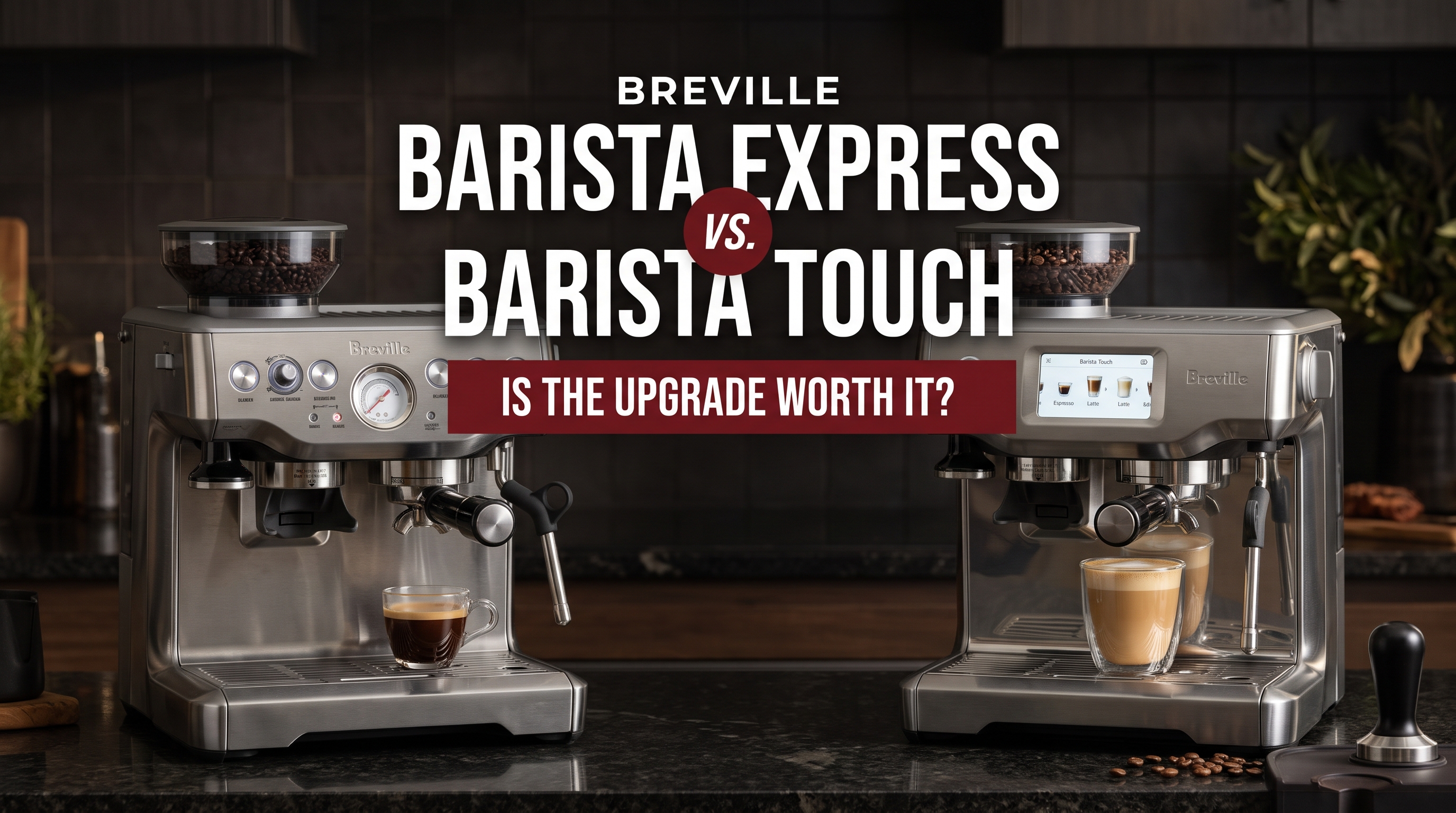
Breville Barista Express vs. Barista Touch: Which Espresso Machine Is Worth It?
Making café-quality espresso at home can be easier when your machine combines a grinder, precise temperature control and a capable milk-steaming system. The challenge is deciding how much automation you actually need.
The Breville Barista Express and Breville Barista Touch both combine espresso preparation and grinding in one countertop machine, but they offer different workflows. The Express gives you more hands-on control, while the Touch adds a touchscreen interface, automatic milk texturing and customizable drink settings.
If you are comparing a Breville Barista Touch espresso machine with the Barista Express, the key question is whether the extra convenience justifies the price difference. A third option, the Meraki Gen 2 Espresso Machine with Grinder, is also worth investigating if you want to compare alternatives.
In this guide, we compare the three options, explain their main differences, and share practical tips for getting better espresso at home.
Breville Barista Express vs. Barista Touch: Quick Comparison
| Feature | Breville Barista Express | Breville Barista Touch |
|---|---|---|
| Brewing system | ThermoCoil heating system with PID temperature control | ThermoJet heating system with PID temperature control |
| Heat-up time | Requires more preparation time than the Touch | Manufacturer states approximately 3 seconds for ThermoJet heating |
| Integrated grinder | Yes, conical burr grinder | Yes, conical burr grinder |
| Grind adjustment | Adjustable grind size and dose | Adjustable grind size and dose |
| Milk steaming | Manual steam wand | Automatic milk texturing with adjustable settings |
| User interface | Physical controls and pressure gauge | Touchscreen with guided drink preparation |
| Drink customization | Manual adjustment and programmable shot volumes | Customizable drinks and saved settings |
| Best suited for | Users who enjoy learning espresso techniques | Users who prioritize convenience and automation |
Specifications and features are based on the manufacturers' product information for the Barista Express and the Barista Touch. Confirm the exact regional model and included accessories before purchasing.
1. Breville Barista Express: Hands-On Espresso at Home
The Breville Barista Express is an all-in-one espresso machine designed for people who want to learn the process of making espresso without purchasing a separate grinder.
Its integrated conical burr grinder grinds coffee directly into the portafilter. You can adjust the grind size, control the dose and manually texture milk using the steam wand.
The machine also features low-pressure pre-infusion, PID temperature control and a pressure gauge that provides feedback during extraction.
What makes the Barista Express worth considering?
Integrated grinding: Freshly grinding beans immediately before extraction helps preserve their aroma and flavor. The built-in grinder also saves counter space compared with a separate grinder.
Manual milk texturing: The steam wand lets you control how much air enters the milk and how the texture develops. With practice, you can produce microfoam for cappuccinos, flat whites and latte art.
Pressure feedback: The pressure gauge offers a useful visual reference while you learn how grind size, dose and tamping affect extraction.
Hands-on control: You can experiment with grind settings, coffee doses and shot volumes to develop a repeatable espresso recipe.
What are the limitations?
The Barista Express requires practice. You need to learn how to dial in the grinder, distribute coffee evenly, tamp consistently and texture milk manually.
It also takes longer to move through a complete milk-based drink workflow than a machine that automates milk texturing. Although the brewing system heats water efficiently, the machine still requires preparation and a separate steaming process.
For someone who enjoys the craft of espresso, those steps are part of the experience. For someone who wants a latte with minimal intervention before work, they may be less appealing.
Who should buy the Barista Express?
Consider this model if you:
- Want to develop barista skills at home.
- Prefer manual control over milk texture.
- Enjoy adjusting espresso recipes.
- Want an integrated grinder without paying for touchscreen automation.
- Need a compact all-in-one setup for everyday espresso.
Our takeaway: The Barista Express is a strong starting point for buyers who value control and want to learn how espresso preparation works.
2. Breville Barista Touch: Espresso With More Automation
The Breville Barista Touch is designed to simplify the process of preparing espresso-based drinks.
Its touchscreen guides you through the main preparation steps, while its ThermoJet heating system is advertised as reaching operating temperature in approximately three seconds. The machine also offers automatic milk texturing with adjustable temperature and texture settings.
You can customize drinks and save preferred settings, which is useful when different household members enjoy different coffee styles.
What makes the Barista Touch different?
Touchscreen drink preparation: Instead of relying primarily on physical controls, the interface guides you through the workflow and provides access to drink settings.
Automatic milk texturing: The machine can texture milk according to selected settings, reducing the need to master manual steaming immediately.
Fast heating system: ThermoJet is designed for rapid heat-up, helping reduce waiting time before extraction. Actual drink preparation still takes longer than the heating time alone.
Saved drink preferences: You can save customized settings for drinks you make regularly, making it easier to reproduce your preferred preparation routine.
Integrated grinder: As with the Express, the grinder lets you adjust the coffee grind without needing a separate appliance.
Is automatic milk texturing worth paying more for?
It depends on how often you make milk-based drinks and how much you value convenience.
If you prepare several cappuccinos or lattes every day, automatic milk texturing may save effort and reduce the learning curve. If you mainly drink espresso or Americano, the advantage may be less significant.
Automation also does not eliminate the need to select suitable coffee beans, adjust grind size, keep the equipment clean or maintain consistent extraction.
The Touch is therefore best viewed as a convenience upgrade rather than a guarantee of better-tasting espresso.
Who should buy the Barista Touch?
Consider this model if you:
- Prefer a guided touchscreen workflow.
- Frequently prepare cappuccinos, flat whites and lattes.
- Want automatic milk texturing.
- Value rapid heating and customizable drink settings.
- Share a coffee machine with people who have different preferences.
Our takeaway: The Barista Touch is appealing for households that prioritize convenience, repeatability and simplified milk-based drinks.
3. Meraki Gen 2 Espresso Machine With Grinder: An Alternative to Breville
The Meraki Gen 2 Espresso Machine with Grinder is another product to compare if you are exploring integrated espresso machines beyond Breville.
It provides an additional option for buyers who want to evaluate the combination of grinding and espresso preparation in one appliance.
Before choosing the Meraki, compare its exact specifications with your requirements rather than assuming it offers the same functionality as either Breville model.
Check the current product listing for:
- Grinder type and adjustment range.
- Heating system and temperature control.
- Available extraction settings.
- Milk-steaming or milk-texturing features.
- Water-tank and bean-hopper capacity.
- Dimensions, warranty and included accessories.
The available product information should determine whether it is a suitable alternative for your workflow and budget. Do not assume it has the same touchscreen functions, automatic milk texturing or heat-up performance as the Barista Touch without confirming those features.
Our takeaway: The Meraki Gen 2 is worth shortlisting when you want a third option in your all-in-one espresso machine comparison.
ThermoCoil vs. ThermoJet: Does Heating Technology Matter?
One of the main differences between the Barista Express and Barista Touch is their heating system.
The Barista Express uses a ThermoCoil system with PID temperature control. The Barista Touch uses ThermoJet technology, which Breville advertises as reaching operating temperature in approximately three seconds.
ThermoCoil: Temperature control for espresso extraction
The ThermoCoil system heats water as it passes through the heating system. PID control helps regulate water temperature during espresso preparation.
Consistent temperature matters because coffee extraction changes with water temperature. If other variables remain constant, temperature differences can alter the balance of acidity, bitterness and other extracted compounds.
The Express still requires preparation time, and the time needed to make a drink depends on grinding, extraction and any milk steaming.
ThermoJet: Faster heat-up
ThermoJet is designed to reach its operating temperature rapidly, reducing the wait before brewing.
This is useful if you make coffee in short windows throughout the day. However, the advertised three-second heat-up time describes the heating system, not the time required to prepare a finished latte.
For either machine, preheating cups when appropriate, using fresh beans and dialing in the grind can matter more to your final cup than simply choosing the faster heating technology.
For detailed technical information, consult the official Barista Express product page and the Barista Touch product page.
How to Dial In the Integrated Grinder
Even an expensive espresso machine cannot compensate for a poorly matched grind setting. Dialing in your grinder is one of the most useful skills you can develop.
Step 1: Start with fresh coffee beans
Choose beans with a roast date where possible and store them in an airtight container away from heat, light and moisture.
Very old beans can produce less satisfying results, while extremely fresh beans may behave differently during extraction depending on the roast and coffee.
Step 2: Start with a consistent dose
Use the filter basket appropriate for your preparation and keep the coffee dose consistent while testing grind settings.
Changing the dose and grind simultaneously makes it difficult to determine which adjustment improved the result.
Step 3: Adjust grind size gradually
If espresso flows too quickly and tastes thin or sour, try a finer grind.
If it flows very slowly or tastes excessively bitter, try a slightly coarser grind.
These are starting points, not absolute rules. Coffee variety, roast level, dose, tamping and machine conditions all influence extraction.
Step 4: Keep other variables stable
When dialing in, avoid changing the grind, dose and beverage volume all at once.
Make a small adjustment, pull another shot and evaluate the taste. Record settings that work well with a particular coffee so you can reproduce the result.
Step 5: Clean the grinder regularly
Coffee oils and retained grounds can affect flavor over time. Follow the manufacturer's instructions for cleaning the grinder, burr area and other coffee-contact components.
Manual vs. Automatic Milk Texturing: Which Is Better?
Milk texture is one of the biggest practical differences between the two Breville machines.
Manual steaming on the Barista Express
Manual steaming gives you control over aeration and texture. With practice, you can produce smooth microfoam suitable for latte art.
The learning process involves positioning the steam wand, introducing air gradually and creating a rolling motion in the milk.
The trade-off is that consistency depends on technique and practice.
Automatic texturing on the Barista Touch
Automatic milk texturing reduces the need to manage the steaming process manually. You select settings for the desired milk temperature and texture, and the machine handles much of the work.
This can make everyday milk-based drinks more convenient, particularly for beginners or households where several people use the same machine.
However, milk type, starting temperature and cleanliness still matter. Follow the manufacturer's guidance for dairy and alternative milks, and clean the steam system as directed.
Which one produces better milk?
Neither method guarantees superior results in every situation.
Manual steaming provides more direct control for people who enjoy developing their technique. Automatic texturing makes the process easier to repeat without as much hands-on skill.
Choose based on whether you value learning and control or convenience and simplified preparation.
Is the Breville Barista Touch Worth the Extra Money?
To evaluate the upgrade, compare the current prices of both models and decide how often you would use the additional features.
The following is a practical decision guide, not a claim that one machine delivers a specific financial return.
| Buying priority | Model to investigate |
|---|---|
| Hands-on espresso preparation | Barista Express |
| Manual milk steaming and latte art practice | Barista Express |
| Touchscreen-guided workflow | Barista Touch |
| Automatic milk texturing | Barista Touch |
| Rapid heating before brewing | Barista Touch |
| A third all-in-one option | Meraki Gen 2 |
Use the actual prices displayed on LBRAWEE when calculating the difference. Promotional prices can change, so avoid basing a purchase decision on an old discount.
The Touch is easier to justify when you frequently make milk-based drinks and value automatic texturing. If you mainly drink straight espresso, the Express may provide the functions you need without paying for automation you rarely use.
Also consider the cost of beans, milk, cleaning supplies, replacement filters and routine maintenance. These recurring expenses affect the overall cost of owning an espresso machine.
How to Maintain Your Espresso Machine
Regular maintenance helps protect coffee flavor and keep your machine operating as intended.
Use suitable water
Follow the manufacturer's water-quality recommendations. Water that is excessively hard can contribute to scale buildup, while unsuitable filtration or water chemistry can also affect performance.
Use a compatible water filter if recommended, and replace it according to the manufacturer's schedule.
Clean the portafilter and baskets
After each session, remove spent coffee grounds, rinse the basket and portafilter, and clean away accumulated residue.
Coffee oils can become rancid and negatively affect flavor if they are allowed to build up.
Clean the steam wand
Wipe the wand immediately after steaming and follow the manufacturer's instructions for purging it.
Regular cleaning helps prevent milk residue from accumulating and blocking the steam outlet.
Follow the descaling instructions
Do not assume every machine should be descaled at the same interval. Water hardness, filtration and the manufacturer's recommendations affect the appropriate maintenance schedule.
Use approved cleaning products and follow the model-specific manual.
Keep the grinder clean
Follow the instructions for removing retained coffee grounds and cleaning accessible grinder components. Avoid exposing electrical components to water.
Breville provides model-specific guidance through its official support and parts pages.
Frequently Asked Questions
Is the Breville Barista Express good for beginners?
Yes, provided you are willing to learn basic espresso preparation. Its integrated grinder and manual controls make it possible to practice grind adjustment, dosing, extraction and milk steaming without buying several separate appliances.
Is the Barista Touch easier to use than the Barista Express?
Generally, yes, particularly for milk-based drinks. Its touchscreen guides preparation and its automatic milk-texturing system reduces the amount of manual steaming required. You will still need to learn how to choose beans, adjust the grind and maintain the machine.
Does the Barista Touch really heat up in three seconds?
Breville advertises approximately three seconds for the ThermoJet heating system to reach operating temperature. This is not the total time required to prepare a drink, which also involves grinding, extraction and possibly milk texturing.
Can both machines make lattes and cappuccinos?
Yes. Both models can prepare espresso and texture milk. The main difference is that the Barista Express uses manual milk steaming, while the Barista Touch offers automatic milk texturing.
Do I need a separate coffee grinder?
Not necessarily. Both Breville models include an integrated grinder. A separate grinder may be worth considering if you want a different grinder design or more flexibility, but it is not required to begin making espresso with either machine.
Is a more expensive espresso machine guaranteed to make better coffee?
No. Coffee freshness, grind consistency, water quality, extraction technique and maintenance all influence the result. Additional automation can improve convenience and consistency, but it does not guarantee a better-tasting cup.
Should I choose Breville or Meraki?
Compare the exact specifications, features, warranty, included accessories and current prices. Breville's two models have documented differences in workflow and milk preparation. For Meraki, verify the current listing before drawing conclusions about comparable features or performance.
Final Verdict: Which Espresso Machine Should You Buy?
The Breville Barista Express and Barista Touch are aimed at different priorities.
The Barista Express is the option to investigate if you want manual control, enjoy learning espresso techniques and prefer to manage milk texturing yourself.
The Barista Touch is worth considering if you want touchscreen guidance, rapid heat-up and automatic milk texturing to simplify your daily coffee routine.
The Meraki Gen 2 provides a third product to compare, but its suitability depends on the exact specifications and features confirmed in its listing.
Before purchasing, compare current prices, confirm the model numbers and review the included accessories and warranty terms.
Ready to upgrade your home coffee setup? Explore the available machines and compare the features that matter most to you.
You can also compare the individual listings: