Choosing the Right Water Heater Starts With Your Hot Water Demand
Replacing an aging water heater often means making a decision quickly, especially when hot water has become unreliable or a leak has appeared. But buying the same tank size you already own is not always the best solution.
A household that runs several showers back to back may need a different configuration from a smaller household that uses hot water throughout the day. Available utility connections, installation space, energy prices and the condition of the existing heating system also affect the choice.
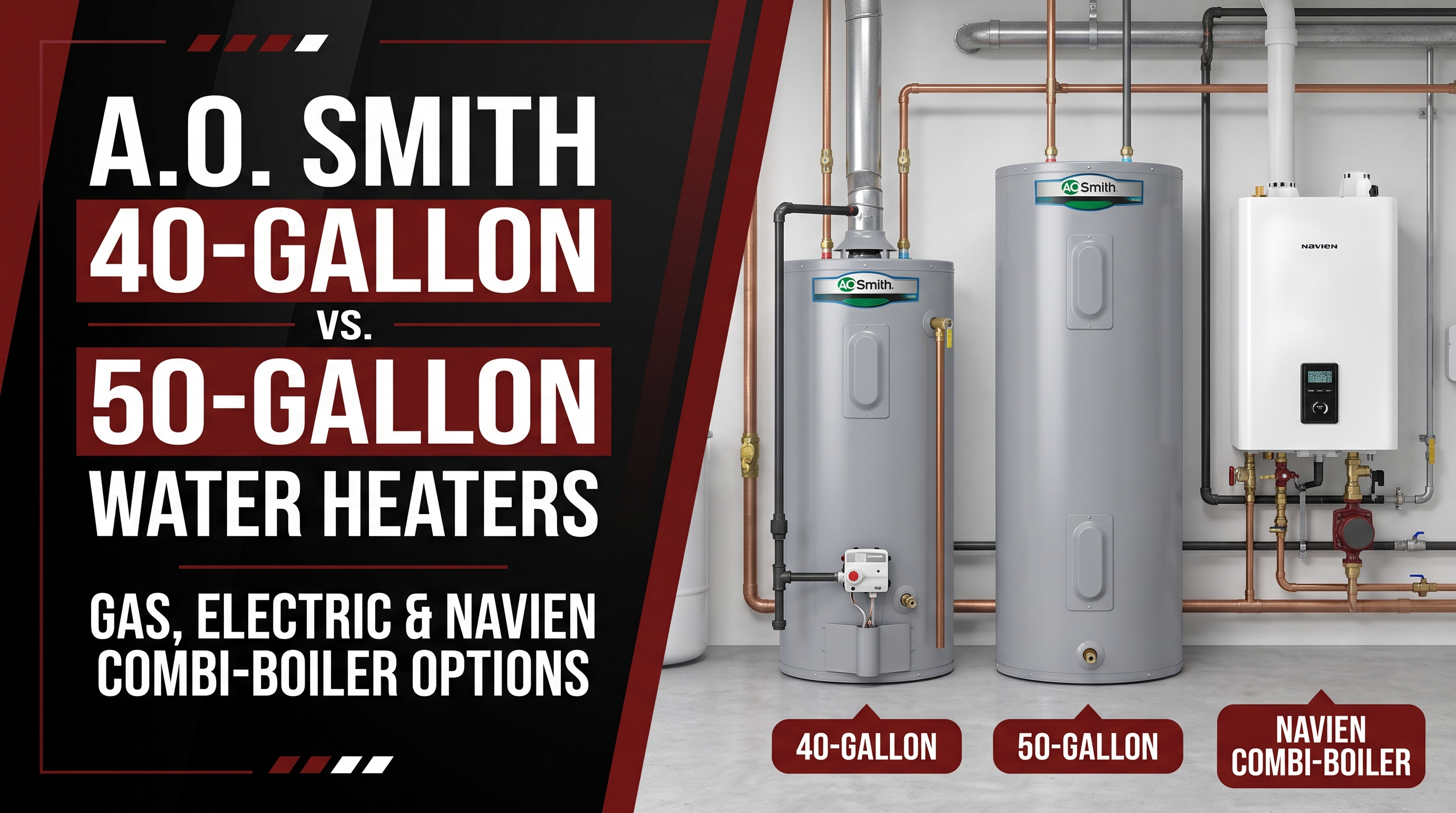
This guide compares three products available from LBRAWEE:
- The A.O. Smith Signature 100 40-gallon short electric water heater.
- The A.O. Smith Signature 100 50-gallon tall natural-gas water heater.
- The Navien NCB-250/150H high-efficiency condensing combi-boiler.
These are not three interchangeable appliances. The two A.O. Smith models store heated water in a tank. The Navien combines domestic hot-water production with space heating in one system.
The right starting point is your household's hot-water demand, not simply the largest capacity or highest BTU number.
40-Gallon vs. 50-Gallon Water Heater: What's the Difference?
A 40-gallon tank stores less water than a 50-gallon tank, but the difference in usable hot water depends on more than nominal capacity. The appliance's recovery performance, incoming water temperature, thermostat settings and the timing of household demand also matter.
A 40-gallon electric tank may suit a smaller household or a property with limited installation height. A 50-gallon gas tank may be worth considering when demand is higher and the property has an appropriate natural-gas connection.
Neither choice is universally better. A correctly sized electric water heater can be a practical replacement when gas is unavailable or unnecessary. A larger gas tank can be helpful when the household needs a greater volume of hot water during busy periods.
Compare the three options
| Feature | A.O. Smith 40-gallon electric | A.O. Smith 50-gallon gas | Navien NCB-250/150H |
|---|---|---|---|
| Appliance type | Storage-tank water heater | Storage-tank water heater | Combination boiler |
| Energy source | Electricity | Natural gas | Natural gas or LP, subject to approved configuration |
| Listed output/input information | Dual 3,800-watt elements | 40,000 BTU gas burner | 210,000 BTU/h domestic hot water; 150,000 BTU/h space heating |
| Hot-water capacity metric | Recovery rate and first-hour rating should be checked | Listed first-hour rating: 84 gallons | Flow rate depends on temperature rise and system conditions |
| Physical format | Short tank, approximately 49.75 inches high | Tall tank, approximately 60.75 inches high | Wall-hung unit |
| Main buying consideration | Electrical capacity and installation space | Hot-water demand and gas/venting requirements | Domestic hot water plus compatible space-heating system |
Specifications are taken from the current LBRAWEE product listings and available manufacturer documentation. Confirm the exact model revision, rating label, included components and installation requirements before ordering.
1. A.O. Smith Signature 100 40-Gallon Short Electric Water Heater
The A.O. Smith Signature 100 E6-40R38D TTP is a short, electric storage-tank water heater designed for locations where the available height is a practical consideration.
LBRAWEE lists the model with dual 3,800-watt heating elements and reports a Uniform Energy Factor (UEF) of 0.88. A.O. Smith's product information for this model identifies dimensions of approximately 49.75 inches high by 20.5 inches in diameter and a recovery figure of 20.7 gallons per hour.
Review the manufacturer's product details and the current EnergyGuide label for the exact unit before relying on its efficiency rating or recovery performance.
What makes this model worth comparing?
Shorter installation profile: Its listed dimensions may make it easier to consider in certain closets or utility spaces than a taller tank. Measure the full installation area, including clearance for connections and future service.
Electric operation: It does not require a natural-gas burner or gas flue, although the electrical circuit and other plumbing requirements must be suitable for the appliance.
Dual heating elements: The product uses two electric elements to heat the stored water. Actual recovery depends on the water temperature rise, thermostat settings and operating conditions.
Storage-tank simplicity: The basic operating principle is familiar: heat water, store it and replenish the supply as hot water is used.
What should you check before buying?
Verify that the existing or planned electrical circuit meets the model's nameplate requirements. Check the tank dimensions, plumbing connections, water-pressure conditions, warranty and the manufacturer's recommended maintenance.
If you are replacing a failed tank, compare the current unit's dimensions with the replacement rather than assuming that nominal 40-gallon capacity guarantees a drop-in fit.
Buyer tip: The listed UEF describes standardized energy performance, not your exact monthly electricity bill. Your utility rate, hot-water habits, incoming water temperature and installation conditions affect actual operating costs.
2. A.O. Smith Signature 100 50-Gallon Tall Natural-Gas Water Heater
The A.O. Smith Signature 100 G12-UT5040NVR is a 50-gallon storage-tank water heater with a listed 40,000 BTU natural-gas burner.
The manufacturer's product information identifies a first-hour rating of 84 gallons. This is important because a tank's ability to meet peak demand depends on both the water it stores and the hot water it can deliver as the burner reheats the supply.
The model is listed at approximately 60.75 inches high and 22 inches in diameter, with a 12-year limited residential warranty specified in the manufacturer's product information. Confirm the warranty conditions and exact model documentation before purchase.
Why consider a 50-gallon gas tank?
More stored water: Compared with a 40-gallon tank, the nominally larger tank holds more water. Whether you need that capacity depends on how much hot water your household uses during its busiest hour.
Documented first-hour delivery: The listed 84-gallon first-hour rating provides a useful comparison point when matching a water heater to household demand.
Natural-gas operation: This may be worth investigating when the property already has a suitable gas service and approved venting arrangement.
Tall-tank dimensions: Make sure the available height, service access, piping and venting arrangements fit the intended installation.
Does a 50-gallon tank automatically suit a family of four or five?
No. Household size is a starting point, not a definitive sizing method. Two families with the same number of occupants may have very different hot-water needs.
Back-to-back showers, a large bathtub, laundry and dishwashing can produce a higher peak demand than a household whose hot-water use is spread throughout the day.
Use the first-hour rating and a realistic estimate of peak demand to make the decision. A.O. Smith's water-heater sizing guide explains how tank capacity, first-hour rating and household usage fit together.
Buyer tip: A higher first-hour rating does not eliminate the need to check gas supply, venting, combustion-air requirements, clearances and local installation rules.
3. Navien NCB-250/150H High-Efficiency Condensing Combi-Boiler
The Navien NCB-250/150H is a different kind of investment from either storage-tank model.
A combination boiler provides domestic hot water and serves a compatible space-heating system. Instead of simply replacing a storage tank, installing a combi-boiler can involve evaluating the home's overall heating arrangement.
According to Navien's manufacturer information, the NCB-250/150H has maximum input ratings of 210,000 BTU per hour for domestic hot water and 150,000 BTU per hour for space heating. It also features dual stainless-steel heat exchangers and built-in connections for three heating zones.
The LBRAWEE product listing states a domestic hot-water flow rate of up to 8.4 gallons per minute at a 45°F temperature rise. Navien's published NCB-H information gives a maximum of 5.4 gallons per minute at a 70°F rise. These are different test conditions, so the figures should not be compared as if the temperature rise were identical.
Consult Navien's official NCB-250/150H product information and manufacturer manuals and specifications for the latest documentation.
When is a combi-boiler worth investigating?
A combi-boiler may be worth investigating when:
- You are replacing an older boiler and a separate domestic hot-water tank.
- The property has a compatible hydronic or other approved space-heating arrangement.
- You want to evaluate a wall-hung appliance that serves both functions.
- You are planning a broader heating-system upgrade rather than a simple tank-for-tank replacement.
What are the trade-offs?
The initial appliance price is only part of the project. A qualified heating contractor must assess gas capacity, venting, condensate disposal, electricity, heating-loop compatibility, system controls and the required domestic-hot-water flow.
A combi-boiler is not a universal replacement for every conventional water heater. If your home uses a separate forced-air furnace and has no compatible space-heating circuit, the proposed conversion may require considerably more work than a storage-tank replacement.
Its advertised flow rate also does not guarantee that several showers and other hot-water outlets can run simultaneously at the desired temperature. Incoming water temperature, target outlet temperature, system configuration and other simultaneous demands influence usable flow.
Buyer tip: Obtain an installation assessment and full project quote before comparing the combi-boiler's appliance price with the cost of a conventional replacement tank.
How to Size a Water Heater Using First-Hour Rating
First-hour rating (FHR) measures the approximate amount of hot water a storage water heater can supply in its first hour of use when starting with a fully heated tank under standardized test conditions.
It accounts for both the water stored in the tank and the water the appliance can heat during that period. That is why tank capacity alone does not tell the whole story.
Step 1: Identify your busiest hour
For many households, the peak hour occurs in the morning or evening when showers, laundry and dishes may overlap.
List the activities that actually occur during that hour instead of adding every hot-water use in the home throughout an entire day.
Step 2: Estimate hot-water demand
A.O. Smith offers the following approximate planning figures in its sizing guidance. Actual use varies by fixture, appliance and household habits.
| Activity during the peak hour | Approximate hot-water demand |
|---|---|
| One shower | 20 gallons |
| One bath | About half the bathtub's capacity |
| Hand dishwashing | 3 gallons |
| Automatic dishwasher | 7 gallons |
| Clothes-washing cycle | 20–25 gallons |
For a simplified example, imagine a peak hour involving two showers, one automatic dishwasher cycle and a clothes-washing cycle. Using the approximate figures above, the estimated demand would be:
- Two showers: 2 × 20 = 40 gallons.
- Dishwasher: 7 gallons.
- Laundry: 20–25 gallons.
The resulting planning estimate is 67–72 gallons during the peak hour.
This is only an illustrative estimate. Actual fixture usage, appliance cycles, incoming water temperature and whether the activities overlap will affect the result.
Step 3: Compare your estimate with the first-hour rating
Look for an appliance whose documented first-hour rating meets or exceeds the estimated peak demand, while also considering the manufacturer's sizing recommendations and the home's plumbing requirements.
The A.O. Smith 50-gallon gas model in this guide lists an 84-gallon first-hour rating. That makes it a candidate for comparison against the example demand, but it does not establish that every household with the same usage will have identical results.
The 40-gallon electric model should be evaluated using its exact first-hour rating and recovery information. Do not assume that two tanks of different sizes—or two tanks using different fuels—will deliver the same amount of usable hot water.
For a detailed assessment, use the manufacturer's sizing resources and ask a qualified installer to verify the selection.
Gas vs. Electric Water Heater: Which Costs Less to Run?
There is no universal answer. The operating cost depends on local gas and electricity rates, the appliance's tested efficiency, incoming water temperature, the amount of hot water used and standby losses.
A lower purchase price does not necessarily mean a lower total cost over the appliance's life.
Electric storage-tank heaters
An electric tank heats water using resistance elements. When evaluating one, check:
- The current EnergyGuide label and UEF.
- The cost of electricity in your area.
- The recovery rate and first-hour rating.
- The electrical service and circuit requirements.
- The purchase price, expected maintenance and warranty.
The A.O. Smith 40-gallon model may be attractive when a short tank and electric service suit the property. Confirm the model's current efficiency documentation and actual operating requirements before making a cost comparison.
Natural-gas storage-tank heaters
A gas tank uses a burner to heat stored water. Its purchase and operating costs depend on the burner rating, recovery performance, gas price, standby losses and the installation conditions.
Before buying, confirm the gas connection, approved venting, combustion-air requirements and any code-related installation work. The cost of adapting an unsuitable existing installation can materially change the economics.
How to make a fair cost comparison
Compare the actual models using their current EnergyGuide estimates, documented efficiency information and local utility rates. Include installation, required electrical or gas work, maintenance and warranty differences.
Do not assume that gas is always cheaper than electricity, or that an efficiency rating alone predicts the monthly bill. The relevant prices and the household's usage pattern can change the outcome.
For additional background, see the U.S. Department of Energy's resources on purchasing energy-efficient residential water heaters.
When Should You Upgrade From a Tank to a Combi-Boiler?
A combi-boiler deserves a closer look when the project involves both domestic hot water and space heating. It is generally a more substantial system decision than replacing one storage tank with another.
Before requesting a quote, determine whether the home currently has a separate boiler, a hydronic heating loop, an air handler supported by the proposed equipment, or a completely different heating system.
Ask your contractor to assess:
- Domestic hot-water demand: How many fixtures are likely to run together, and what flow rate is required at the desired temperature?
- Space-heating load: What heating output does the home need during the coldest expected conditions?
- Compatibility: Can the existing distribution system, controls and piping work with the proposed boiler?
- Fuel and venting: Are the gas supply, venting materials and installation location suitable for the exact model?
- Condensate and drainage: What condensate management and other installation provisions are required?
- Electrical requirements: Does the proposed installation meet the manufacturer's electrical specifications?
- Total installed cost: How do the equipment, labor, system changes, permits and ongoing maintenance compare with a conventional replacement?
The Navien NCB-250/150H has separate maximum input ratings for domestic hot water and space heating. Those ratings serve different functions; the higher domestic-hot-water input is not a statement of the home's space-heating requirement.
If your priority is simply replacing a leaking or undersized tank, a storage-tank model may be the more straightforward project. Consider a combi-boiler when the overall system and household requirements justify a wider upgrade.
Installation and Maintenance: What Buyers Should Check
A water heater is a connected plumbing and energy appliance. Buying the right product does not remove the need for a safe, code-compliant installation.
Pressure relief and expansion provisions
Check the temperature-and-pressure relief valve requirements and the manufacturer's installation instructions. Where the plumbing system requires a thermal expansion tank or other pressure-control measures, those provisions should be assessed during installation.
Never block, cap or otherwise obstruct a relief-valve discharge line.
Electrical and gas connections
Electric models must be connected to an appropriately rated circuit. Gas models require suitable fuel supply, venting and combustion-air provisions. Combi-boilers have additional requirements associated with both domestic hot water and space heating.
Have the relevant work performed by qualified professionals and obtain required permits or inspections.
Temperature and scald protection
Follow the manufacturer's guidance and applicable plumbing requirements when setting water temperature. Hotter settings can increase scald risk; the appropriate configuration depends on the household, fixtures and any required mixing or anti-scald provisions.
Routine service
Follow the exact manual for inspections, maintenance and component replacement. Depending on the appliance, this may include checks of the tank, anode rod, heating elements or burner, venting, condensate system and other components.
A storage-tank water heater and a condensing combi-boiler do not have identical maintenance needs. Compare the service requirements and warranty terms as part of the purchase decision.
Which Product Should You Shortlist?
Choose the A.O. Smith 40-gallon electric model for further evaluation if:
- You prefer or require an electric storage-tank heater.
- The shorter tank dimensions suit the available installation space.
- Its documented first-hour rating and recovery characteristics meet your household's peak demand.
- The existing or planned electrical service is suitable.
Compare the A.O. Smith 50-gallon gas model if:
- Your home has an appropriate natural-gas supply.
- Your peak hot-water demand justifies investigating a larger storage tank.
- The listed first-hour rating aligns with your calculated need.
- The installation location can meet the model's dimensions, venting and service requirements.
Investigate the Navien combi-boiler if:
- You are considering a combined domestic-hot-water and space-heating system.
- The existing or planned heating arrangement is compatible.
- A qualified contractor confirms that its heating capacity and hot-water performance suit the home.
- You have compared the complete installed cost rather than just the appliance price.
Frequently Asked Questions
Is a 40-gallon water heater enough for a family of three?
It may be, but the number of occupants is not enough to determine the answer. Shower lengths, back-to-back use, appliance cycles, first-hour rating and recovery performance all matter. Estimate the busiest hour and compare it with the exact model's documented performance.
Is a 50-gallon gas water heater better than a 40-gallon electric water heater?
Not automatically. The gas model stores more water and lists an 84-gallon first-hour rating, whereas the electric model has different recovery and electrical characteristics. The right comparison depends on hot-water demand, operating cost, installation suitability and available utilities.
What is first-hour rating, and why does it matter?
First-hour rating estimates how much hot water a storage-tank appliance can deliver during the first hour starting with a fully heated tank. It incorporates both stored hot water and the appliance's ability to heat more water while operating. It is a better peak-demand comparison metric than nominal tank capacity alone.
Is a combi-boiler the same as a tankless water heater?
No. A combi-boiler provides domestic hot water and space heating in one appliance. A conventional tankless water heater serves domestic hot-water demand but does not necessarily provide space heating. The equipment's purpose, connections and installation requirements differ.
Can I replace a tank water heater with a Navien combi-boiler myself?
This should be treated as a system-design and professional installation project, not a simple tank swap. The gas supply, venting, condensate, electrical connections, controls and heating distribution must meet the manufacturer's instructions and applicable local requirements.
Should I choose gas or electric based on efficiency alone?
No. Standardized efficiency ratings are useful, but local energy rates and household usage affect operating costs. Compare the exact products' EnergyGuide information, installation requirements, purchase costs and expected maintenance before deciding.
Final Water Heater Buying Checklist
Before placing an order, confirm:
- The exact model number and its current manufacturer documentation.
- First-hour rating and recovery performance against your estimated peak demand.
- Physical dimensions and installation clearances.
- Fuel, electrical and plumbing requirements.
- The complete installation cost, including any required gas, venting, circuit or plumbing work.
- Warranty coverage and maintenance requirements.
- Any local permits, inspections or code requirements.
- Whether a storage tank or a combi-boiler genuinely suits the home's current heating system.
The best water heater is the one that meets your actual hot-water demand, fits the property, and offers a sensible total cost of ownership.
Ready to compare your options? Browse the LBRAWEE Home Deals collection and review the exact specifications for each product before making your shortlist.
FURTHER READING
- A.O. Smith — What Size Water Heater Do I Need?
- A.O. Smith — 40-Gallon Short Electric Water Heater, Model E6-40R38D-TTP
- A.O. Smith — 50-Gallon Tall Natural-Gas Water Heater, Model G12-UT5040NVR
- Navien — NCB-250/150H Official Product Information
- Navien — NCB-250/150H Manuals and Technical Downloads
- U.S. Department of Energy — Purchasing Energy-Efficient Residential Water Heaters
- LBRAWEE — Existing Home Upgrade Buying Guide
- LBRAWEE — Home Deals